A trading family and a bird photographer
Hasselblad was a business long before it was a camera. In 1841 Fritz Victor Hasselblad founded a trading house in Gothenburg, on Sweden's west coast, selling fabrics, sewing supplies and household goods. In 1885 his son Arvid met George Eastman on his honeymoon in London, and with a handshake the family firm became the Swedish distributor for Eastman's photographic plates and film. Three years later, Eastman's company became Kodak.
Victor Hasselblad, Arvid's grandson, was born in 1906. At eighteen he was sent abroad to learn the photographic trade in camera and film factories in Germany, France and the United States, and in 1926 George Eastman took him on at Kodak in Rochester. He brought home at least one Kodak habit, as you'll see when you read a serial number.
Victor's real passion was birds. In 1935 he published a book of photographs of migrating birds, and in its foreword he admitted that more than nine in ten of its pictures were taken with a Leica, the best camera he could get. He wasn't happy with them. A 35 mm negative didn't hold enough detail for a small bird far away. He wanted a bigger negative, in a camera he could carry into the field.
"I can make one better"
In 1940, with war all around neutral Sweden, the Swedish Air Force showed Victor a German aerial reconnaissance camera that had come down on Swedish soil and asked whether he could make one like it. As he told the story many years later, he looked it over, saw nothing special, and answered: "No, I cannot make one like that, but I can make one better."
He set up a workshop in a shed beside a car repair shop in central Gothenburg, with a junkyard next door for raw materials, and worked evenings with a mechanic and the mechanic's brother. Within months he had a factory with twenty people. Between 1941 and 1943 they built 240 of the HK-7, a hand-held aerial camera with interchangeable lenses and controls big enough to work with flying gloves on. A later reconnaissance camera, the SKa 4, had interchangeable film backs. Both ideas, big controls and backs that come off, would come back.
1948: a camera for everyone else
After the war Victor turned to the camera he'd wanted all along. On 6 October 1948 he unveiled it at a press conference in New York. It was simply called the Hasselblad, and it was the first medium-format single-lens reflex with interchangeable lenses, film magazines and finders: the four-piece system you took apart in your first lesson.
It was also fragile. To photograph birds in flight, Victor wanted a very fast shutter, and the camera had a focal-plane shutter, a pair of curtains running just in front of the film, made of stainless steel only six ten-thousandths of an inch thick, with a top speed of 1/1600 of a second. The people who built it were mostly watchmakers, superb at fine parts but not used to making something that would be carried around and knocked about. Of the first 269 cameras assembled, 153 came back to the factory for repairs.
The successor, the 1000F of the early 1950s, slowed the shutter to 1/1000 and toughened it, and Zeiss lenses replaced the original Kodak ones. Ansel Adams was an early fan. He had offered to test the first camera, and for years he sent Hasselblad notes on its design.
Why square?
No document records Victor explaining the choice, but the logic of the square is easy to see once you've used one. A waist-level finder is very awkward to turn on its side, and a square frame never needs turning: you compose once, and decide later whether the print is upright, wide or square. The 6 × 6 frame was also already familiar from the Rolleiflex, the German twin-lens camera that dominated medium format. It was big enough for very fine prints, and small enough for a camera you could hold.
In 1955 Victor hosted Reinhold Heidecke, co-creator of the Rolleiflex, and the two men photographed each other. They're said to have agreed, informally, that Hasselblad would never make a twin-lens reflex and Rollei would never make a single-lens one. For a while, both kept to it.
1957: the shutter moves into the lens
The 500C of 1957 is the direct ancestor of your camera, and it settled the design for the next fifty-six years. Victor dropped the troublesome focal-plane shutter and put a leaf shutter, a ring of blades made by Compur, inside every Zeiss lens instead.
Critics weren't impressed by a top speed of only 1/500. But a leaf shutter opens fully at every speed, so electronic flash works all the way up to 1/500, which made the 500C a natural studio and wedding camera. Each lens shut down to its working aperture automatically at the moment of exposure, so you could focus with it wide open. And because the lens shutter has to stand open while you look through the camera, the body gained the second set of blinds you watched in slow motion. About 76,700 500Cs were made.
One lens wouldn't fit. The superb wide-angle Zeiss Biogon 38 mm sits so close to the film, only 18.8 mm, that there's no room for a mirror. Zeiss said the lens was worth a camera body of its own, and Hasselblad built one: the mirrorless Superwide, which later became a favorite of Lee Friedlander's.
Into orbit
In 1962 the astronaut Wally Schirra wanted a better camera for his Mercury flight. His own story, which he told for the rest of his life, was that he walked into a Houston photo shop and came out with a Hasselblad 500C. However it was bought, NASA's engineers stripped it for space: the leather covering, the mirror and the finder came off, it was painted matte black against reflections in the window, and it got a sight on the outside and a magazine for far more frames than twelve. On 3 October 1962 it orbited the Earth six times aboard Sigma 7.
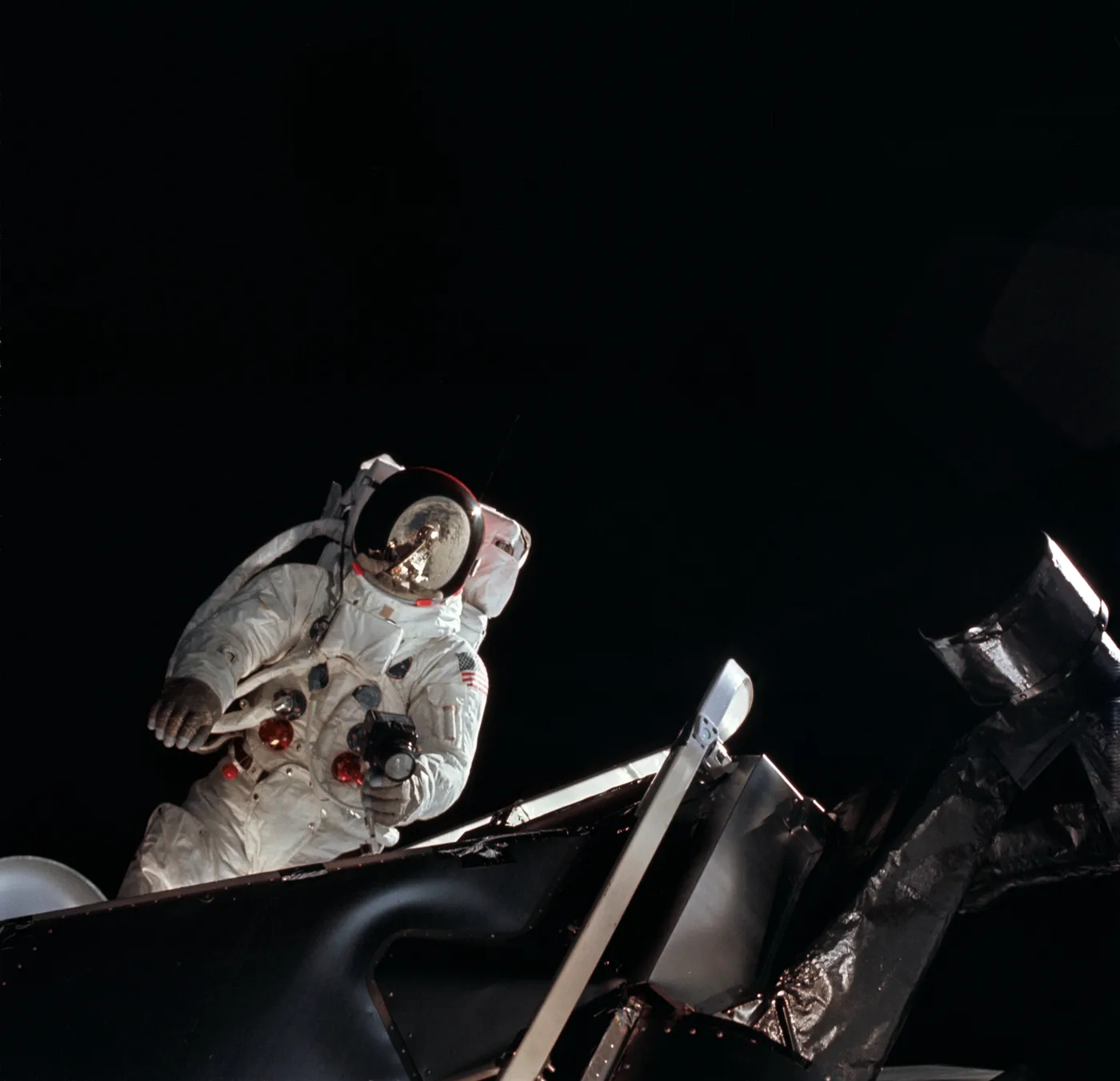
According to the Hasselblad Foundation, NASA had flown modified 500Cs on several missions before the company noticed. When James McDivitt's photographs of Ed White's 1965 spacewalk were published, Hasselblad offered to build cameras for space, and a partnership began that lasted until 2003. Not every camera came home. In July 1966 Michael Collins let go of his Hasselblad during a spacewalk on Gemini 10, and it drifted off into orbit. When Victor later met him, he's said to have remarked: "We couldn't buy that kind of publicity."
On the Moon
For Apollo, Hasselblad supplied versions of the 500EL, its camera with a built-in electric motor, so astronauts in pressurized gloves didn't have to turn a crank. On Christmas Eve 1968, Bill Anders used one with a 250 mm lens to photograph the Earth rising over the Moon. Frank Borman joked, "Hey, don't take that, it's not scheduled," and Jim Lovell called out the exposure: 250 at f/11.
For the surface, Hasselblad built the Data Camera. It had a silver finish to keep it cool in the sun, a new Zeiss Biogon 60 mm lens designed for NASA, and a glass plate in front of the film engraved with small crosses ten millimeters apart, which appear on every frame so scientists could measure the Moon from the pictures. Hasselblad says it had to work from above 120 °C in sunlight to −65 °C in shadow.
Weight was the tightest budget on the trip home, so the astronauts brought back the film magazines and left the cameras behind. Hasselblad says twelve of its camera bodies are still on the Moon, one reason the company likes to say its cameras have been there since 1969.
The 503CX
Back on Earth, the manual 500 series kept improving slowly. The 500C/M of 1970 let you change the focusing screen yourself. Then, in 1988, came the 503CX, the camera on your bench. Its 1988 manual calls it an upgraded 500C/M, and what it added was subtle:
- Flash metered off the film. A sensor in the body watches the light bouncing off the film itself during the exposure and tells a dedicated flash when to stop. The flash's batteries power it; the camera itself still has none.
- A much brighter screen. The Acute-Matte focusing screen made the ground glass far easier to see and focus on. The manual notes that it was designed by Minolta.
- A darker inside. A new anti-reflection coating inside the body cut flare.
Everything else, the mechanism you've learned, the lenses, the magazines, is shared with the 500C/M, and the same manual covers both. Two features came later and are worth knowing when you shop. The 503CXi of 1994 added a connection for a motor winder. The 503CW of 1996 added the Gliding Mirror System, a mirror that slides back as it swings up, so the finder image isn't cut off with long lenses. On a 503CX, a 150 mm lens shows a slightly darkened band along one edge of the screen. The picture on the film is unaffected.
The end of the line, and after
Victor sold the company in the late 1970s and died in 1978. He and his wife Erna left most of their fortune to a foundation in Gothenburg, which gives the Hasselblad Award and runs the Hasselblad Center. The company passed through several owners. It launched the autofocus H system in 2002, merged with the Danish digital-back maker Imacon in 2004, and since 2017 has been controlled by the Chinese drone maker DJI.
Film cameras couldn't hold out against digital forever. In April 2013 Hasselblad announced that the last 503CW had come off the line, ending the system it now calls the V system after fifty-six years. Its chief executive said demand had fallen sharply over the previous five years.
That isn't quite the end. Every V-system body since 1957 shares the same rear connection, so a digital back can take the place of the film magazine. In 2024 Hasselblad released the CFV 100C, a 100-megapixel back that it says fits most of its film cameras made after 1957. Put one on a 503CX and the camera on your bench becomes a modern digital camera, with the same crank, the same lenses and the same view down into the hood.
Reading your camera's birthday
Here's the Kodak habit Victor brought home. Kodak hid the year of manufacture in a code word, and Hasselblad did the same, with the word VHPICTURES. Each letter stands for a digit:
| V | H | P | I | C | T | U | R | E | S |
|---|---|---|---|---|---|---|---|---|---|
| 1 | 2 | 3 | 4 | 5 | 6 | 7 | 8 | 9 | 0 |
The two letters in a body's or a magazine's serial number are the year. A 503CX marked RR was made in 1988, RE in 1989, ES in 1990. From 1990, a few numbers before the letters identify the product type, and you can ignore them. Zeiss lenses don't use the code; you'll find how to date a lens in Owning one.
Timeline
| Year | What happened |
|---|---|
| 1841 | F.W. Hasselblad & Co. founded in Gothenburg as a trading house |
| 1885 | Arvid Hasselblad and George Eastman shake hands: the firm distributes Eastman's products in Sweden |
| 1906 | Victor Hasselblad born |
| 1940–43 | The Swedish Air Force's request; the HK-7 aerial camera, 240 made |
| 1948 | The first Hasselblad (later called the 1600F) launched in New York |
| 1952–53 | The 1000F: a slower, tougher focal-plane shutter |
| 1954 | The first Superwide, with the Biogon 38 mm and no mirror |
| 1957 | The 500C: a leaf shutter in every lens |
| 1962 | Wally Schirra's 500C orbits the Earth on Sigma 7 |
| 1965 | The 500EL, with a built-in motor |
| 1968 | Earthrise, Apollo 8 |
| 1969 | Hasselblad Data Cameras on the Moon, Apollo 11 |
| 1970 | The 500C/M: a focusing screen you can change |
| 1978 | Victor Hasselblad dies; the Foundation follows in 1979 |
| 1988 | The 503CX: flash metered off the film, the Acute-Matte screen |
| 1994 | The 503CXi, with a winder connection |
| 1996 | The 503CW, with the Gliding Mirror System |
| 2013 | The last 503CW: the end of V-system production |
| 2017 | DJI takes control of Hasselblad |
| 2024 | The CFV 100C digital back, made to fit V-system bodies |
Check yourself: why did the 500C move the shutter from the body into each lens?
A 503CX body's serial number contains the letters EV. When was it made?
Sources
- Hasselblad, company history: hasselblad.com/about/history (Victor Hasselblad; How it all started; Erna & Victor; The first consumer camera; The 500 series; Hasselblad in space).
- Hasselblad Foundation, "The Hasselblad camera" and "Hasselblad": hasselbladfoundation.org.
- Hasselblad Historical (Q.G. de Bakker, with Richard Nordin, Charlie Chernoff and Stefan Heymann): the Ross military cameras, the Series One 1600F ledger, Victor's bird photography, the model table and the dating guide: hasselbladhistorical.org. Victor's account of the Air Force request is quoted there from Evald Karlsten, Hasselblad: I Am the Camera (1981).
- Victor Hasselblad AB, 503CX & 500C/M instruction manual, 1988, and the 1600F instruction book (scans at Hasselblad Historical).
- Carl Zeiss lens data sheets for the Planar 80 C and CF and the Biogon 38 CF (at Hasselblad Historical).
- NASA, "60 years ago: Astronaut Schirra orbits the Earth six times aboard Sigma 7"; Gemini X mission page; Apollo Flight Journal for Apollo 8, orbit 4: apollojournals.org; Apollo Lunar Surface Journal, "Hasselblad cameras on Apollo 11".
- NPR / New Hampshire Public Radio, "The camera that went to the Moon and changed how we see it", 2019, with Jennifer Levasseur of the National Air and Space Museum.
- Amateur Photographer, "Hasselblad to cease production of legendary V System cameras", April 2013.
- Hasselblad press releases: 907X and CFV II 50C (2019, 2020) and 907X & CFV 100C (2024), and the CFV 100C FAQ.
- TechCrunch, "DJI acquires Hasselblad", January 2017.
Where sources disagree, we've followed the earliest primary source and said so: the 503CX's introduction (1988, per the manual), and the sale of the company (1976 or 1978) and the 1000F (1952 or 1953), which we've left as "late 1970s" and "early 1950s".