Why this camera keeps turning up
From the late 1950s until well into the digital era, a Hasselblad was one of the most common cameras in professional hands. Studio, wedding and fashion photographers used them, and so did NASA, which flew modified Hasselblads from 1962 through the Space Shuttle years.
The reasons are the ones you've met on the bench. The negative is big: a 6 × 6 frame has more than three and a half times the area of a 35 mm frame, so prints stay sharp and smooth at large sizes. The magazines come off, so one camera can carry color and black and white, or a fresh roll ready to go. The shutter is in the lens, so flash works at every speed. And the whole thing is mechanical and very hard to break, which mattered a great deal on the Moon.
As you read about each picture, ask two questions: why square? and what did this particular camera make possible that another wouldn't have?
In orbit and on the Moon
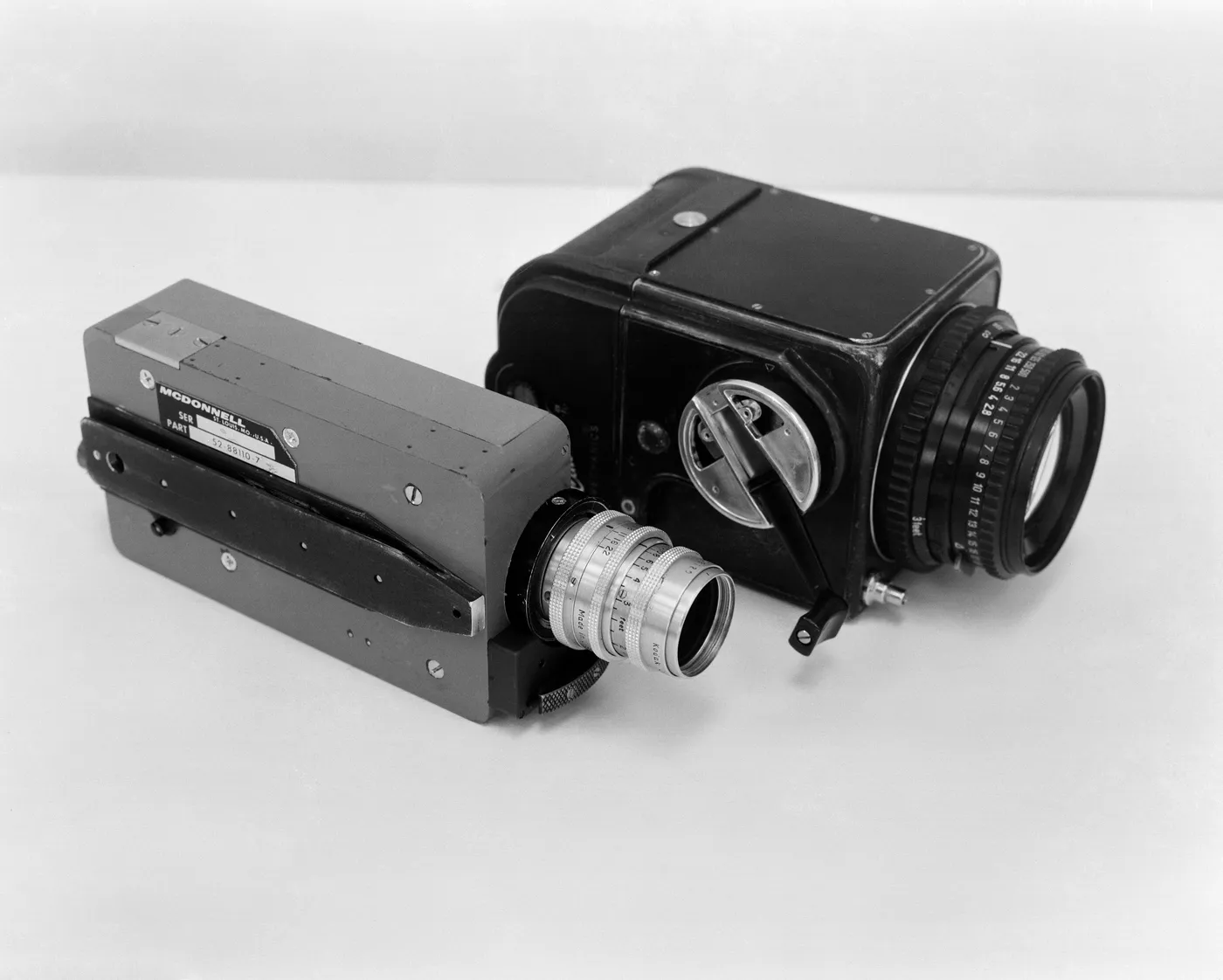
The story starts in 1962, when the astronaut Wally Schirra took a Hasselblad 500C with an 80 mm Planar lens, the same standard lens as yours, into orbit on Mercury-Atlas 8. NASA's photographers liked the results, and Hasselblad became the agency's main still camera for decades. The cameras were modified for space, with larger controls for gloved hands, 70 mm film magazines with room for many more frames, and later electric motors to wind them, but the optics and the basic design were the ones you've just learned.
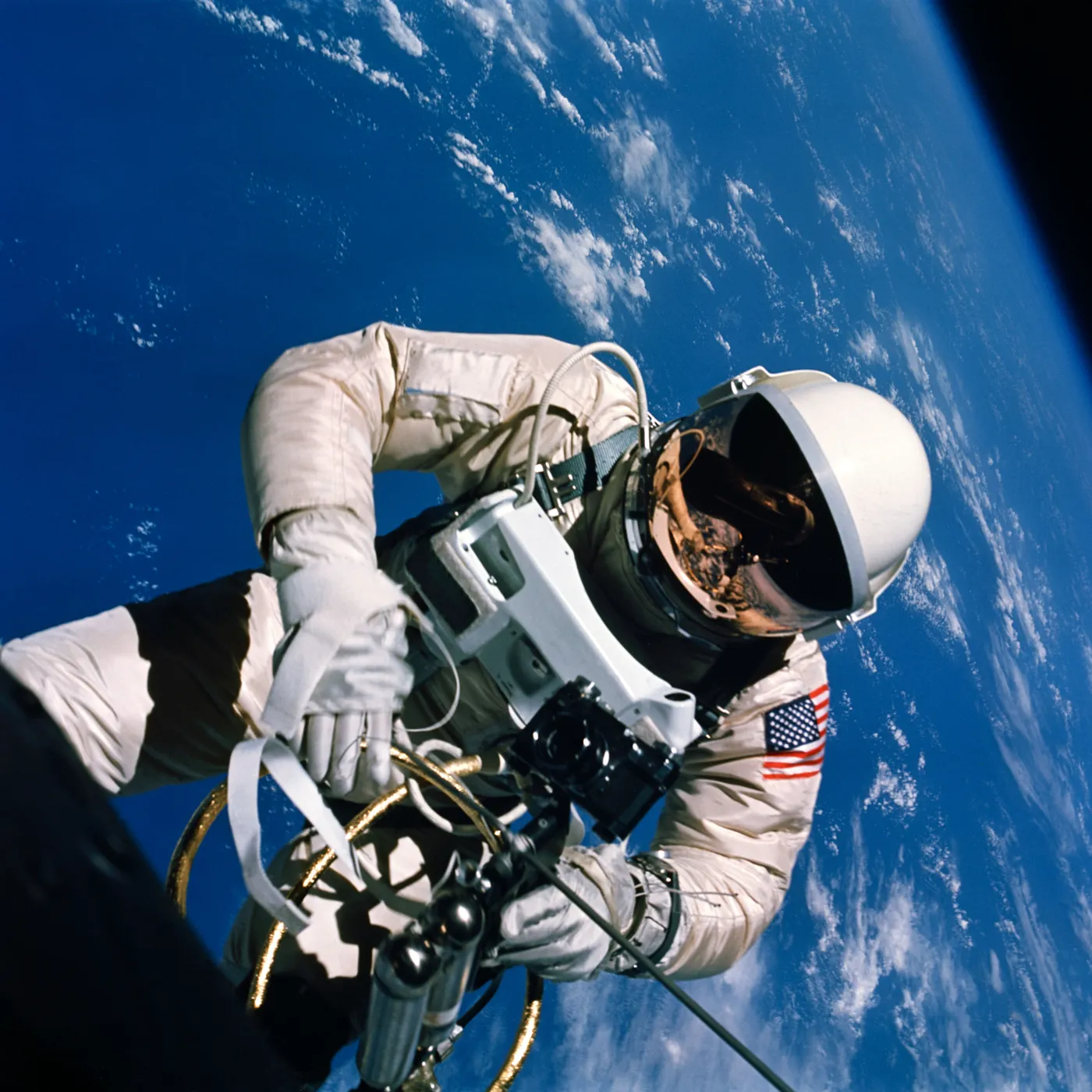
Ed White's spacewalk, 1965
Photographer: James McDivitt · Camera: modified Hasselblad 500C · Mission: Gemini IV, 3 June 1965
The first American to float outside a spacecraft was photographed by his crewmate through the open hatch. It's often called the first still photograph of a person in open space. White carried a small 35 mm camera of his own on his maneuvering gun, but this is McDivitt's frame.
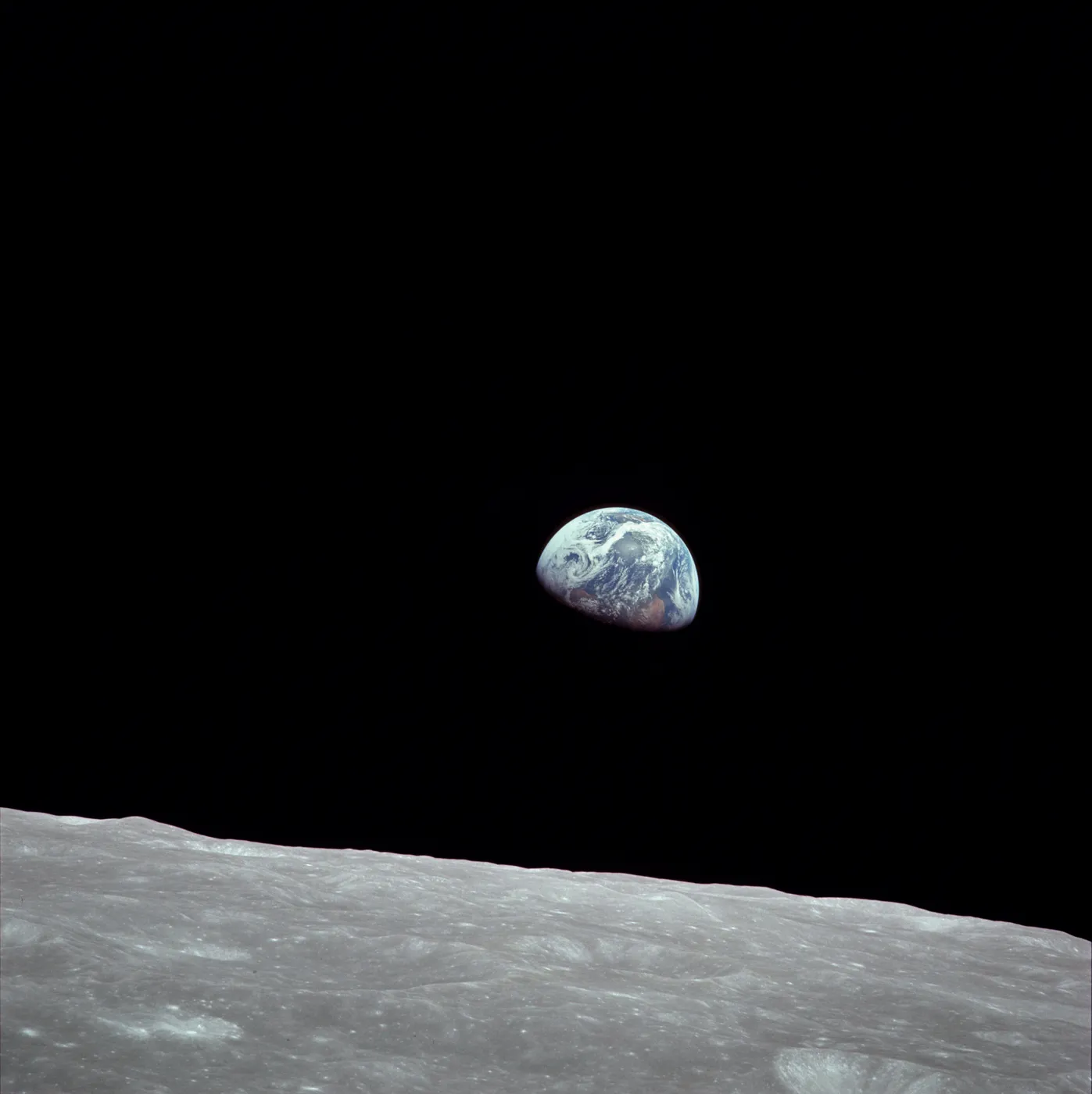
Earthrise, 1968
Photographer: Bill Anders · Camera: modified Hasselblad 500 EL, 250 mm lens · Film: 70 mm Kodak Ektachrome · Exposure: 1/250 at f/11 · Mission: Apollo 8, 24 December 1968
Anders was photographing the lunar surface on black-and-white film when the spacecraft rolled and the Earth came over the horizon. "Oh my God, look at that picture over there!" he said, and asked for color film. Frank Borman pointed out that it wasn't on the schedule; Jim Lovell found a color magazine and passed it over. Anders took two frames. This is the second.
The long lens matters. At 250 mm, the Earth and the Moon's horizon are flattened onto one plane, which makes the Earth look large and close against the rim. A wider lens would have shown a tiny blue dot.
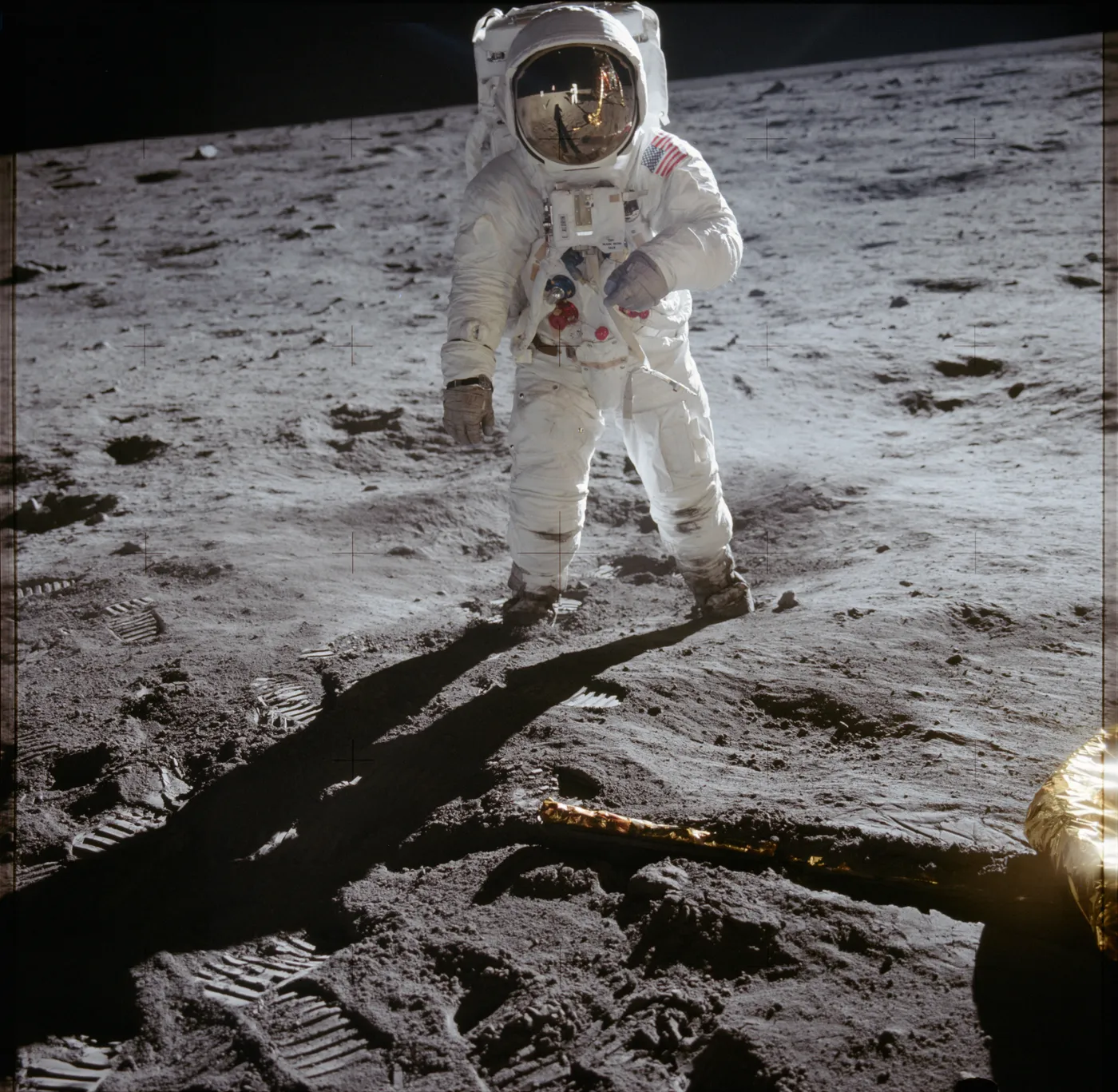
Buzz Aldrin on the Moon, 1969
Photographer: Neil Armstrong · Camera: Hasselblad Electric Data Camera, chest-mounted, Zeiss Biogon 60 mm · Mission: Apollo 11, 20 July 1969
Look in Aldrin's visor and you'll see the photographer, with the camera strapped to his chest. Armstrong took nearly all the photographs on the surface, which is why there are so few good pictures of the first man on the Moon. The small crosses scattered over the frame were etched on a glass plate in front of the film, so scientists could measure distances in the pictures afterwards.
The film came home. The cameras didn't: to save weight, the astronauts brought back only the magazines, and left the camera bodies and lenses on the surface. Hasselblad says twelve of its cameras are still on the Moon.
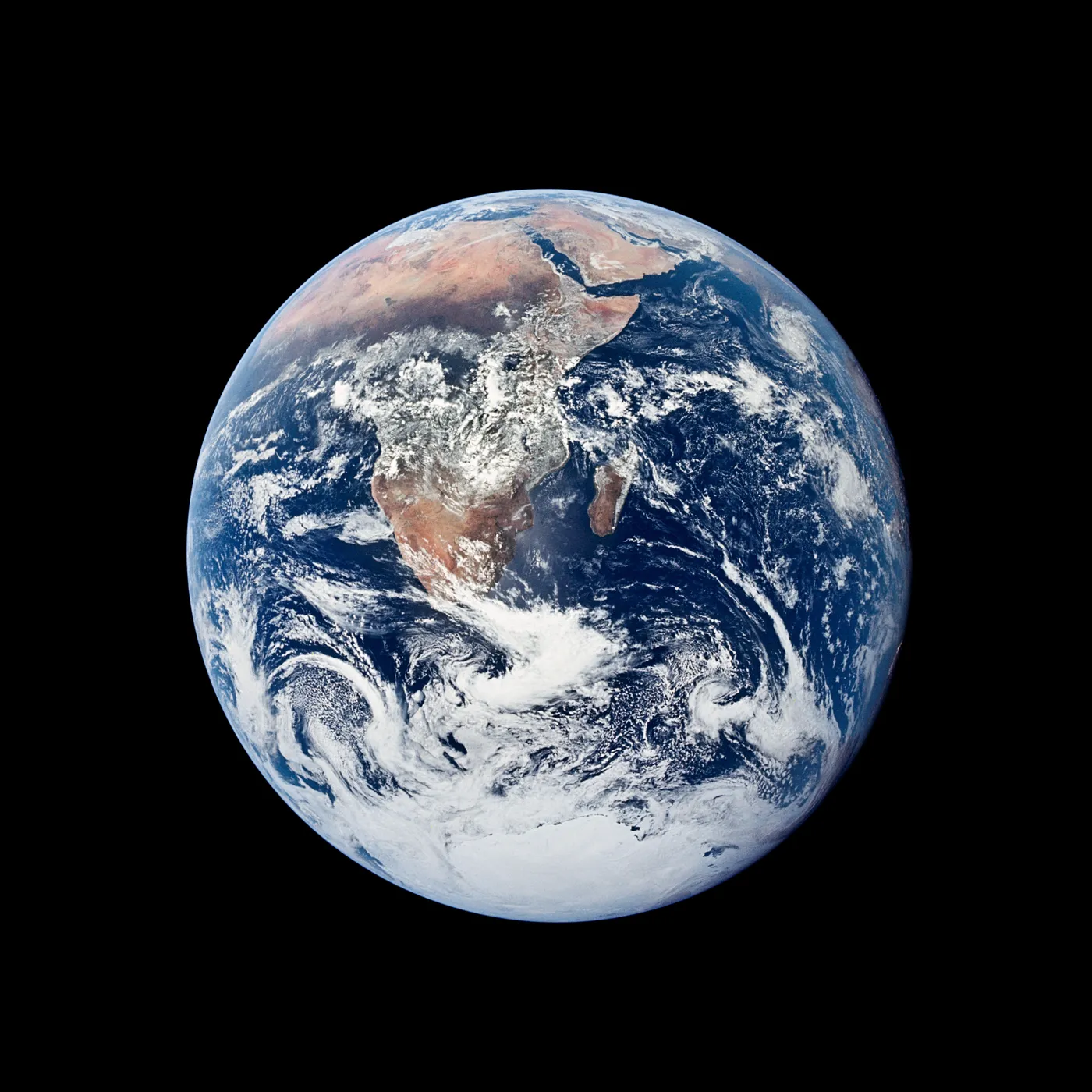
The Blue Marble, 1972
Photographers: the Apollo 17 crew · Camera: Hasselblad 500 EL, 80 mm Zeiss Planar · Mission: Apollo 17, 7 December 1972
About five hours after launch, with the Sun behind the spacecraft, the crew saw the Earth fully lit for the first time, including the ice cap at the South Pole. It's usually credited to Harrison Schmitt, though the Apollo Flight Journal points to Ron Evans, and NASA credits all three.
It was made with an 80 mm lens, the same focal length as yours. You'll sometimes see an exposure of f/2.8 at 1/250 quoted for it. There's no NASA source for that, and it would have overexposed a sunlit Earth by several stops, which is a good reminder to check a famous number before you repeat it.
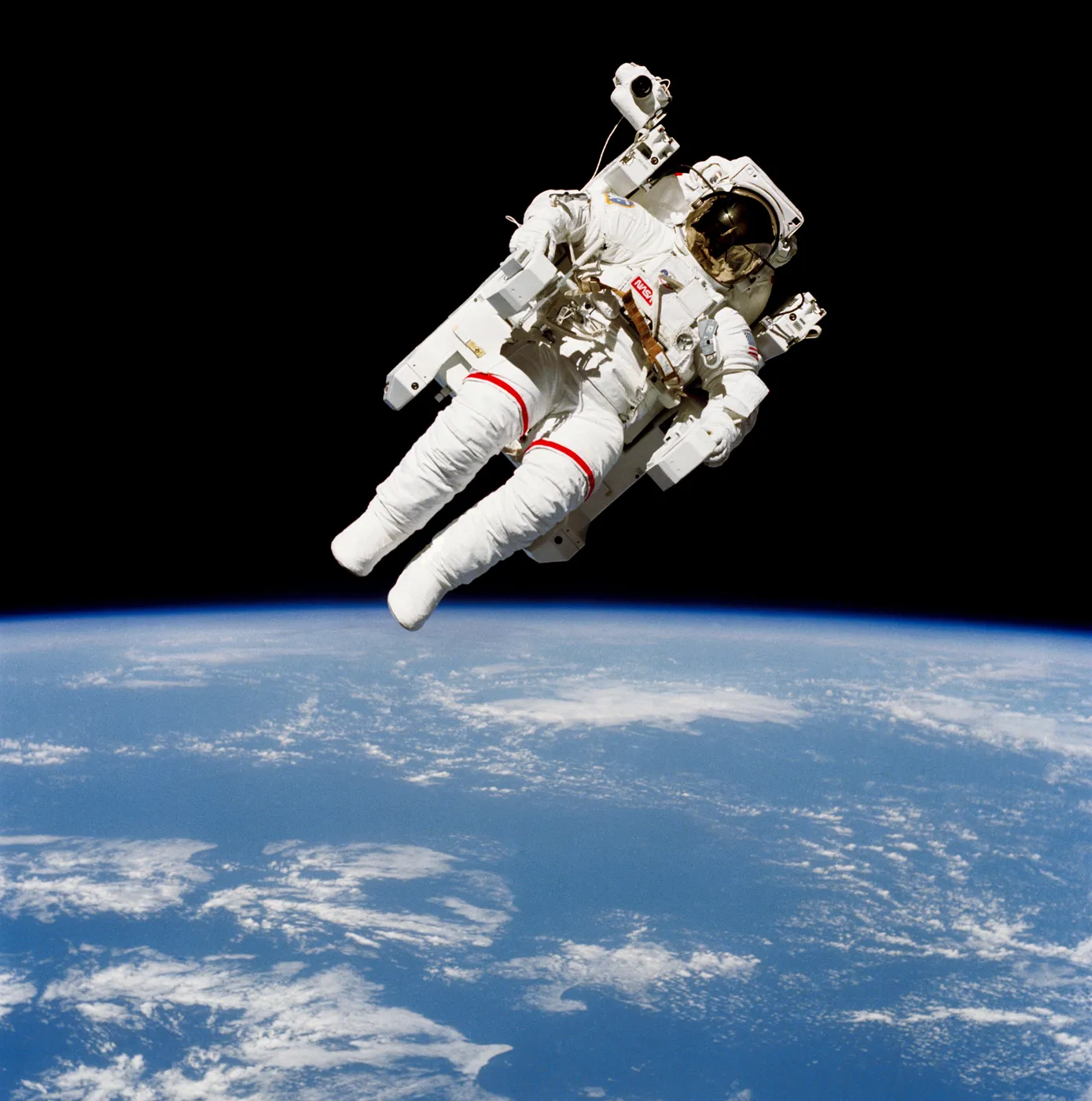
Bruce McCandless flies free, 1984
Photographer: Robert "Hoot" Gibson · Camera: Hasselblad, 70 mm · Mission: Space Shuttle STS-41B, 7 February 1984
The first untethered spacewalk was photographed through the Shuttle's rear windows by a pilot who had nothing else to do during it. Gibson took his job seriously: NASA's account says he metered three times and checked focus four times for every frame, and tilted the camera to level the horizon, which he thought looked wrong at an angle. Careful technique, not luck, is why these frames are so clean.
On the ground
See it at the Ansel Adams Gallery ↗
Ansel Adams, Moon and Half Dome, 1960
Camera: Hasselblad 500C, 250 mm Zeiss Sonnar · Place: Yosemite Valley, 28 December 1960, late afternoon
Adams is best known for big view cameras, but he was also one of Victor Hasselblad's earliest supporters. After the first Hasselblad appeared in 1948, he offered to test it, and he sent the company notes on its design for years. In 1960 he saw a gibbous moon rising over Half Dome as the shadow climbed its face, and made this picture with a long lens, lifting the mirror before he released the shutter so its jolt couldn't blur the frame. That's the pre-release you practiced on the bench.
In the Yosemite fieldwork you can try the same kind of picture yourself.
The camera, at Bonhams ↗
Iain Macmillan, Abbey Road, 1969
Camera: Hasselblad 500C, reported 50 mm Distagon · Place: Abbey Road, London, 8 August 1969
Paul McCartney sketched the idea, a policeman held up the traffic, and Macmillan stood on a stepladder in the middle of the road. He made six frames in about ten minutes. The fifth was the one where the four men's legs made a clean, even stride. When his camera was sold at auction in 2020, it still had lines drawn on its focusing screen to match the zebra crossing, so he could line the picture up on the ground glass. The square frame went straight onto a square record sleeve.
The foundation ↗
Robert Mapplethorpe, from 1975
Camera: a Hasselblad 500, a gift from Sam Wagstaff in 1975
Mapplethorpe made more than 1,500 Polaroids before Wagstaff gave him a Hasselblad. After that, the Polaroids gave way to the work he's known for: precise, carefully lit square pictures of flowers, portraits and the figure. The camera's square frame and big negative suited his classical, centered compositions and his large prints.
MoMA, 2005 ↗
Lee Friedlander, from the 1990s
Camera: Hasselblad Superwide (SWC), with a fixed 38 mm Biogon
Friedlander spent decades with a Leica. In the early 1990s, wanting to photograph the landscape of the American West, he tried a Hasselblad Superwide, a V-system camera with a very wide fixed lens and no mirror, and he soon used it for everything. MoMA points to the much bigger negative and the unusually sharp, wide lens. His book America by Car is a long sequence of square pictures made from the driver's seat of rental cars, the dashboard and mirrors framing the road.
Interview, 2022 ↗
Michael Kenna, from 1987
Camera: Hasselblad with a waist-level finder
Kenna bought his first Hasselblad, with a waist-level finder like yours, in 1987. He has said that looking down at a reversed image on the ground glass, with the camera held low, changed the way he composes. His quiet, square black-and-white landscapes, often exposed for many minutes at night, are almost all made this way. "I work with Hasselblads most of the time," he told one interviewer.
A myth worth knowing
Vivian Maier, the Chicago nanny whose street photographs were found after her death, is often described as a Hasselblad photographer. She wasn't. Her estate says she bought a Rolleiflex in 1952. The confusion is understandable: a Rolleiflex also makes square 6 × 6 pictures on 120 film, and you also look down into it from waist height. But it's a twin-lens reflex, with one lens for viewing and one for taking, and a fixed lens you can't change. The Hasselblad is a single-lens reflex: you see through the very lens that takes the picture, and you can swap it.
The Hasselblad Award
When Victor Hasselblad and his wife Erna died, they left their fortune to a foundation in Gothenburg. Since 1980 it has given the Hasselblad Award, one of photography's biggest prizes: two million Swedish kronor, a gold medal and an exhibition. Lennart Nilsson won it first, then Ansel Adams in 1981 and Henri Cartier-Bresson in 1982. Later winners include Irving Penn, Richard Avedon, Cindy Sherman, Hiroshi Sugimoto, Lee Friedlander and Nan Goldin.
The award honors photographers, not users of the camera. Cartier-Bresson worked with a Leica, and Sugimoto with large view cameras. Only a few winners, Adams and Friedlander among them, are known Hasselblad photographers.
Looking closely
Take any of these pictures and work through these questions. They're good for a class discussion, too.
- Where is the main subject in the square: centered, or off to one side? What would change if the frame were a 35 mm rectangle?
- Was the lens wide, normal or long? What does that do to the space between near and far things?
- What did the photographer have to do before the moment arrived? Think of Macmillan's lines on the ground glass, and Adams lifting the mirror.
- Which feature of the camera mattered most here: the big negative, the interchangeable magazines, the leaf shutter, the waist-level finder, or its toughness?
Then go and make your own. The fieldwork has six assignments, in the studio and in Yosemite, built around these pictures.
Sources
- Hasselblad, "Hasselblad in space": hasselblad.com/about/history/hasselblad-in-space, and the 1969 Moon-landing press release.
- NASA image library records and captions for S65-17399, S65-30431, AS08-14-2383, AS11-40-5903, AS17-148-22727 and S84-27017: images.nasa.gov.
- NASA Science, "The story behind Apollo 8's famous Earthrise photo": science.nasa.gov; NASA Goddard visualization 4593: svs.gsfc.nasa.gov/4593.
- Apollo Lunar Surface Journal, "Apollo 11 Hasselblad": apollojournals.org.
- NASA History, "Photos from STS-41B": nasa.gov/history/photos-from-sts-41b.
- The Ansel Adams Gallery, Moon and Half Dome: anseladams.com; Hasselblad Foundation, "The Hasselblad camera": hasselbladfoundation.org.
- Bonhams, lot 185, sale 25996 (Iain Macmillan's Hasselblad 500C), 2020; Amateur Photographer, "How the Abbey Road album cover was shot".
- Robert Mapplethorpe Foundation, biography: mapplethorpe.org; J. Paul Getty Museum, "In Focus: Robert Mapplethorpe".
- Museum of Modern Art, press release for Friedlander, 2005: moma.org.
- Michael Kenna, interview, Popular Photography, 2022: popphoto.com; Light & Land interview.
- Vivian Maier estate, "About Vivian Maier": vivianmaier.com.
- Hasselblad Foundation, "About the Hasselblad Award" and the list of winners: hasselbladfoundation.org.