Cameras/2.8F
2.8F
Two lenses, one for looking and one for taking, with a coupled meter that needs no battery.
- Turn on the cutaway and fire it: the fixed mirror stays still while the leaf shutter opens, then the crank winds on by itself.
- Press Finder to watch the hood spring up around the focusing screen.
- Fit one of the close-up lens pairs from the lens menu; the upper lens of each pair corrects for parallax.
Shoot a roll with the 2.8F
Its square frame suits the Loft Studio's still life and portraits, and the close-up lens pairs bring small objects on the table up close.
The 2.8F, feature by feature
Plays from YouTube (privacy-enhanced mode). Nothing loads from YouTube until you press play. Privacy
The 2.8F
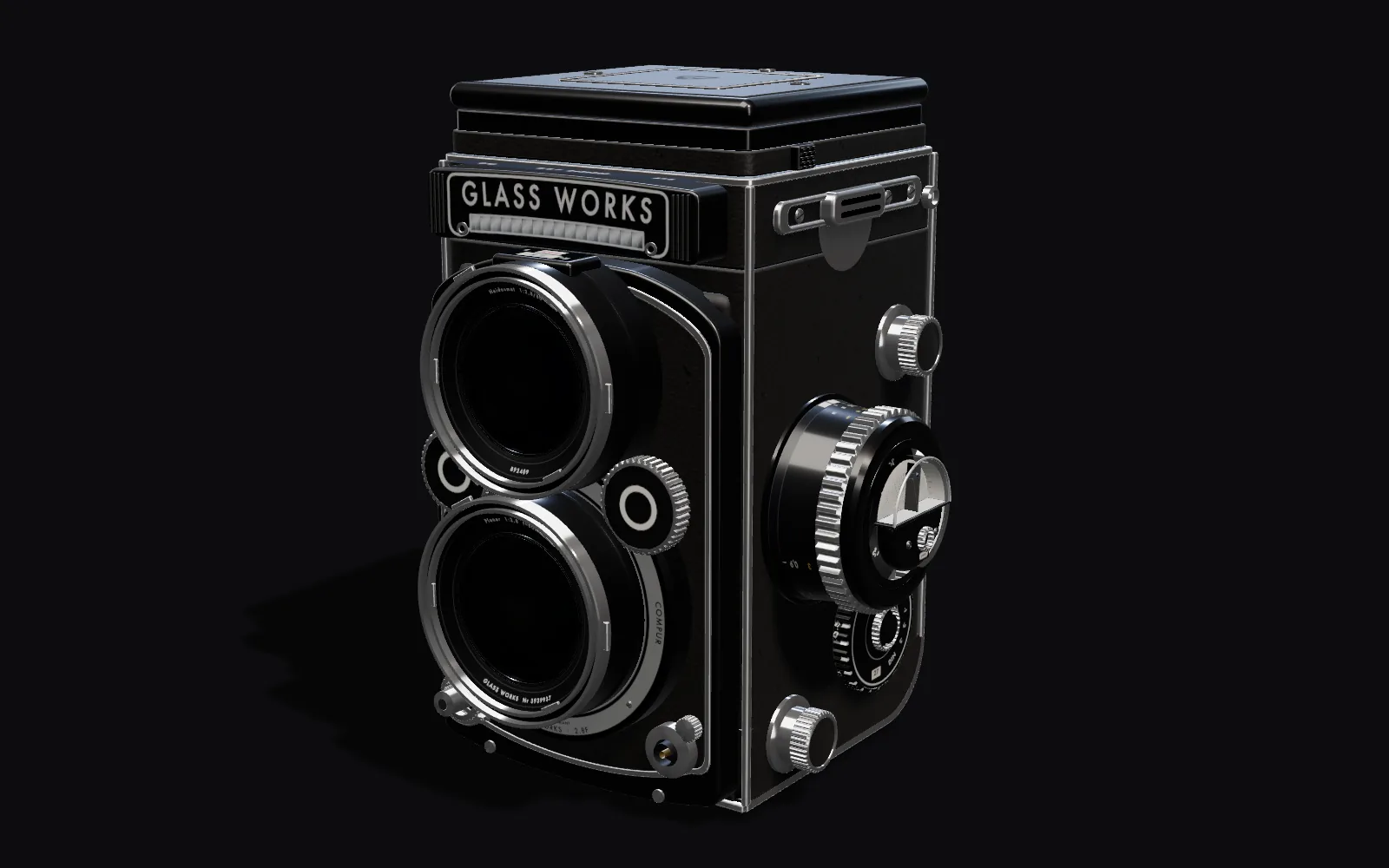
The first camera of this line was made in Braunschweig, Germany, in 1929. It is a twin-lens reflex. Two lenses of the same focal length sit one above the other on a single front panel. The upper one forms the image you look at, by way of a fixed mirror and a focusing screen. The lower one, with the shutter built around it, takes the picture. Because the mirror never moves, the view never goes dark when you fire.
In 1937 the Automat model brought a frame counter that works by touch. Two small rollers feel the extra thickness where the film begins on its backing paper, start the counter, and stop the crank at frame one. You no longer had to read frame numbers through a red window in the back. The 2.8F loads the same way, and after the twelfth frame its crank turns freely to wind the roll off.
The 2.8F came out in 1960 and was made until 1981, in several versions, about 82,200 cameras in all. What the F added was a meter coupled to the controls. On the earlier E models you read the meter and carried the number over by hand. On the F, a selenium cell above the viewing lens drives a needle, and a second pointer is moved by both setting wheels through a small differential gear. Line the two up, and the exposure is right.
Later versions added a counter for 220 film from the end of 1965, and a white front plate in 1971. Gold and platinum special editions followed in the 1980s. Through all of them the camera kept its shape: the hood on top, the two lenses in front, the focusing knob on the left and the crank on the right, with the speed and aperture wheels between the lenses, under your thumbs.
The controls, one by one
The waist-level finder
Lift the back edge of the hood and the lid and walls spring up around the screen. The picture is upright but reversed left to right. Press the front panel gently and a magnifier rises over the center; press it all the way in and the hood becomes a sports finder.
Focusing
The big knob on the left moves the whole front panel, carrying both lenses together, so the screen and the film agree about what is sharp. A white band around the knob shows the depth of field, and it spreads wider as you close the aperture.
Parallax
The viewing lens sits a few centimeters above the taking lens, so up close it sees a slightly different picture. The camera corrects for this as you focus: in the model, a mask under the screen slides across, moving the frame you see toward the one the film will get.
Shutter and wheels
The leaf shutter in the taking lens runs from one second to a five-hundredth, plus B, and works with electronic flash at every speed. The right wheel between the lenses sets the speed, the left sets the aperture from f/2.8 to f/22, and a window on top shows both.
The coupled meter
The selenium cell behind the row of small windows above the viewing lens makes its own current from light. Its readout sits on top of the focusing knob: a needle that follows the light and a pointer moved by both wheels. Bring the two together and the exposure is right.
The crank
Swing the crank out, turn it forward to the stop and back to the stop. That one motion moves the film on, turns the counter and cocks the shutter. It won't turn again until you have fired, and the release won't work until it is back, so frames can't double up or be skipped.
What it is
| Format | 6×6 cm on 120 film, 12 frames |
|---|---|
| Shutter | Leaf shutter in the taking lens; X contact for electronic flash at all speeds, M for bulbs |
| Speeds | 1 s to 1/500 s and B; self-timer about 10 s |
| Meter | Selenium cell, coupled to the speed and aperture wheels |
| Finder | Removable waist-level hood with magnifier and sports finder; split-image wedge |
| Lenses | Fixed 80 mm f/2.8 taking lens and 80 mm f/2.8 viewing lens; bayonet size III for shades, filters and close-up pairs |
| Power | None |
| Made | Braunschweig, Germany, 1960–1981; about 82,200 |
4 lenses
- 80 mm ƒ/2.8 StandardStandard
- 80 mm ƒ/2.8 + close-up lens 1Close-up
- 80 mm ƒ/2.8 + close-up lens 2Close-up
- 80 mm ƒ/2.8 + close-up lens 3Macro
Why it lasted
The 2.8F was made for more than twenty years, and its makers marked the line with gold and platinum editions after regular production ended. It needs nothing but film. The mirror is fixed, so there is no mirror slap and the view never blacks out; the leaf shutter fires with a quiet click; and the selenium meter makes its own current from the light it measures. Every setting can be read from above, through the window on top and the meter on the knob, so the camera is worked from the waist without lifting it to the eye.
Use this 3D model, or build another
The 2.8F and its 4 lenses are built procedurally in Three.js from millimetre measurements — no external meshes or textures — and published under the MIT licence.