Cameras/4×5
4×5
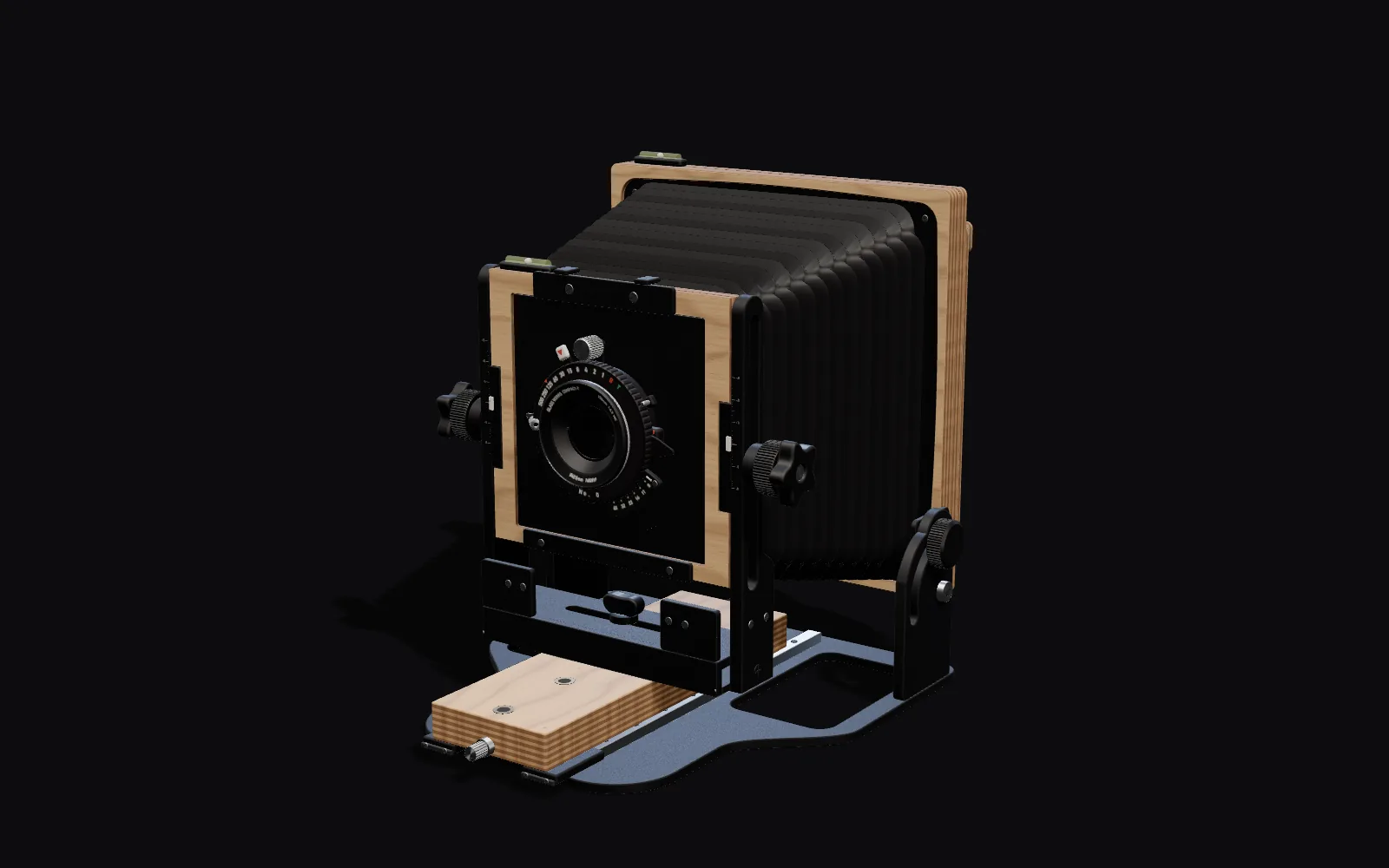
A folding view camera of birch and aluminum, with every part that makes the picture in plain sight.
- Press Fold to watch it pack itself flat step by step, then press it again to set it back up.
- Press Finder to lay the dark cloth over the back.
- Turn on the cutaway and fire it to see the glass and the iris inside the lens, or swap the 150 mm for the 75 mm or the 300 mm.
Shoot a roll with the 4×5
Its movements suit Yosemite's cliffs and meadows, where a little front tilt brings near flowers and far trees sharp together on the glass, and its slow, exact working suits still life in the Loft Studio.
The 4×5 field camera, feature by feature
Plays from YouTube (privacy-enhanced mode). Nothing loads from YouTube until you press play. Privacy
The 4×5
This is the newest camera in the collection. It began as a university design project in Brighton, England, in 2013. In October 2014 it went to crowdfunding with a target of £27,000 and reached it in under two days. The aim was a 4×5 field camera that was light and affordable, made by hand in the company's own workshop. The first cameras came out in 2015, and each one is still assembled by hand in Brighton.
Like every view camera, it is two frames joined by a bellows. The front standard holds the lens on a flat board, and the rear standard holds the ground glass and, later, the film. An aluminum base with two linear guides carries the front, and a focus wheel at the back racks it toward the film or away. The bellows stretch from 75 mm to 300 mm, which sets the range of lenses the camera can use.
It has been revised several times since the first version. The one modeled here is the fifth generation, from 2022. Its front and rear standards are birch plywood sealed with wax and oil, its base is aluminum, and the whole camera weighs 1.3 kg. Folded flat, with the bellows squeezed between the standards, it is about 18 cm square and under 10 cm deep.
There is no mirror, no meter and no electronics. Each picture is a single sheet of film, four inches by five. You compose on the ground glass under a dark cloth, with the picture upside down, and every decision is made there before a sheet goes in. The front movements let you keep tall buildings upright and lay the plane of focus along the ground, which is the reason view cameras exist.
The controls, one by one
Ground glass and dark cloth
With the shutter held open, the picture appears on the ground glass upside down, with left and right swapped, because there is no mirror or prism to turn it back. A dark cloth over the back and your head brings it up out of the daylight, and a half-inch grid helps keep lines straight.
The lens and shutter
The 150 mm f/6.3 is the standard lens for 4×5, its focal length close to the diagonal of the frame. Its leaf shutter runs from one second to a five-hundredth, plus B and T. A lever cocks it, and a press-focus lever holds the blades open while you compose and focus with a loupe.
Rise, fall and shift
Loosen the inner knobs and the lens slides up as much as 42 mm, or down 30. Keep the camera level and raise the lens, and tall buildings stay upright instead of leaning in. Shift does the same sideways, up to 30 mm, set at the wing nut at the foot of the front standard.
Tilt, swing and Scheimpflug
The outer knobs tilt the lens up to 45 degrees either way, and swing turns it left or right as far. Tilt the lens and the plane of focus tilts too: the film's plane, the lens's plane and the plane of focus meet in one line. A few degrees forward lays it along the ground.
The back and the film holder
The back turns all the way round on magnets with click stops, so landscape to portrait is a quarter turn. A holder carries two sheets, each under a dark slide. Close and cock the shutter, slide the holder in, pull the slide, fire, and push the slide back with EXPOSED facing out.
Folding flat
To pack it, the lens comes off on its board, the front is unscrewed from the base and every movement goes back to zero. The front is pushed back against the rear, the bellows squeezed between them, and both fold down onto the base. Setting up is the same in reverse.
What it is
| Format | 4 × 5 in sheet film, two sheets to a holder |
|---|---|
| Shutter | Leaf shutter in the lens, with cocking lever and press-focus lever |
| Speeds | 1 s to 1/500 s, B and T (150 mm lens) |
| Meter | None |
| Finder | Ground glass with a half-inch grid, under a dark cloth; back rotates 360° |
| Lens mount | 96 × 99 mm lens boards; lenses from 75 mm to 300 mm; bellows 75–300 mm |
| Movements | Front rise 42 mm, fall 30 mm, shift 30 mm, tilt and swing ±45°; rear tilt |
| Weight | 1.3 kg; folded 180 × 180 × 97 mm |
| Made | By hand in Brighton, England; this fifth generation from 2022 |
6 lenses
- 75 mm ƒ/5.6 Super-WideWide
- 90 mm ƒ/5.6 WideWide
- 135 mm ƒ/5.6 Moderate WideWide
- 150 mm ƒ/6.3 StandardStandard
- 210 mm ƒ/5.6 PortraitPortrait
- 300 mm ƒ/9 Long FocusTele
Why it lasted
The 4×5 field camera showed that a new large-format camera could still be designed, funded and sold in the 2010s. Its crowdfunding drew 495 backers and more than twice its target, and the camera has been revised four times since. Its lens boards are a common large-format size, so almost any large-format lens, old or new, can be fitted on the right board. Nothing on it stops a mistake: fire with the slide in and the sheet stays blank. It teaches the slow habits of the format, one sheet and one decision at a time.
Use this 3D model, or build another
The 4×5 and its 6 lenses are built procedurally in Three.js from millimetre measurements — no external meshes or textures — and published under the MIT licence.