Cameras/AE-1
AE-1
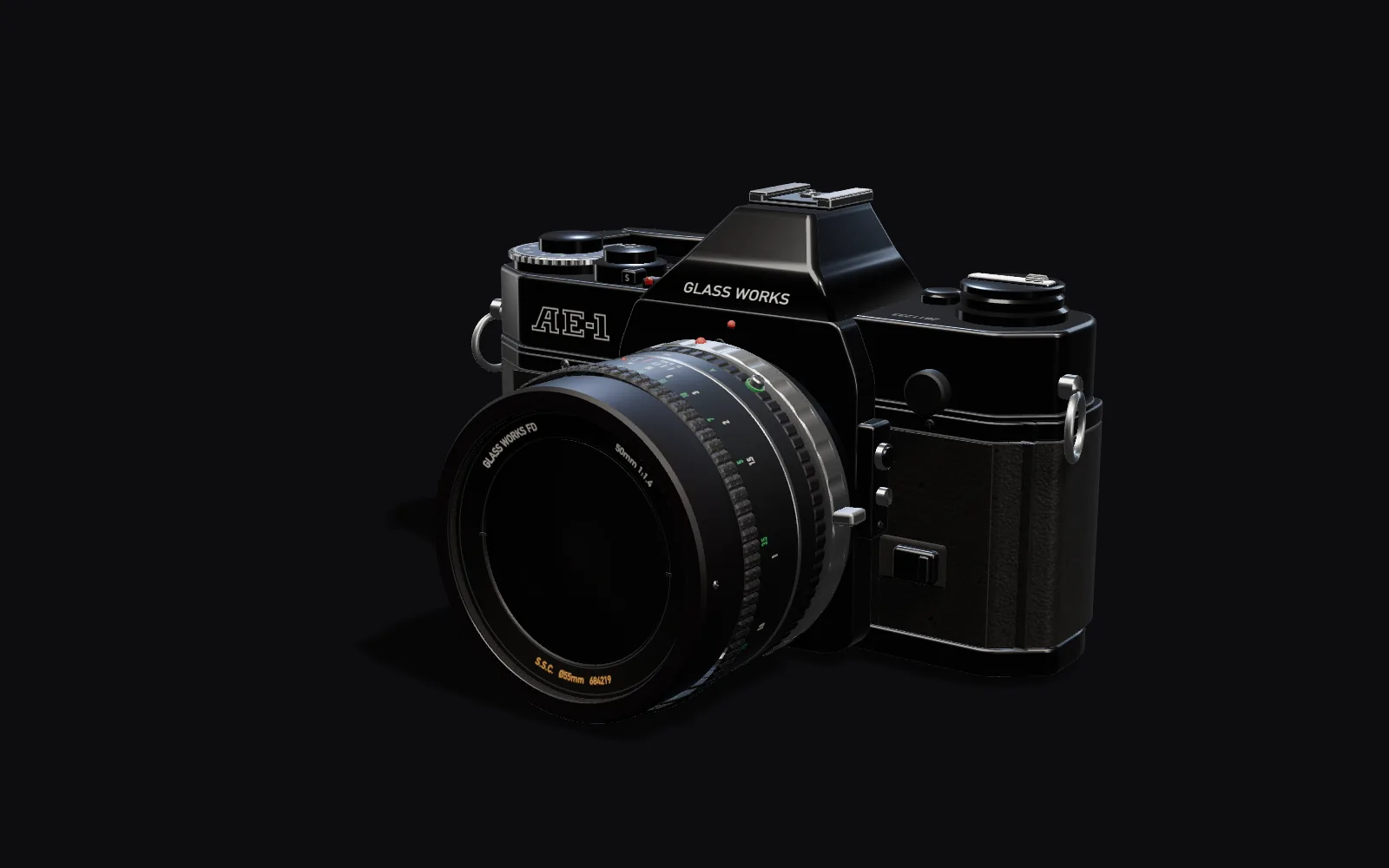
You choose the shutter speed and its electronics choose the aperture: an automatic SLR meant for anyone.
- Turn on the cutaway and fire it to watch the mirror swing up and the cloth curtains cross the film.
- Take it apart in the exploded view: lens, top plate with the prism and controls, body, back and base plate.
- Swap the 50 mm f/1.4 for the 24 mm wide lens or the 135 mm tele.
Shoot a roll with the AE-1
Shutter priority suits Yosemite's falls and rivers, where the speed you choose decides whether the water freezes or flows, and the Test Lab's grey cards show how its center-weighted meter reads.
The AE-1, feature by feature
Plays from YouTube (privacy-enhanced mode). Nothing loads from YouTube until you press play. Privacy
The AE-1
The AE-1 began in January 1974, after the oil shock. Its maker put about a hundred engineers on a plan for an automatic camera that anyone could use, at a price ordinary buyers would pay. At the time most SLRs were metered by hand, and automatic models were expensive top-end cameras made in small numbers. The answer was to give electronics the work that springs, levers and cams had done before.
The camera was unveiled in April 1976. Its maker describes it as the first camera with a built-in microcomputer: a few custom chips at the center, two integrated circuits and a larger logic chip, that read the meter, set the lens and time the shutter. By its maker's count the electronics took about three hundred parts out of the camera, and much of the assembly was automated.
It was designed as five major units and twenty-five smaller ones, all under central electronic control. That made it a low-cost camera with features from more expensive ones, and it sold. By October 1977, a year and a half after launch, more than a million had been made. Its maker says the automated, computer-controlled technology developed for it led directly to the A-1 of 1978.
The controls, one by one
Shutter priority
The dial on the right of the top plate sets the shutter speed, from a thousandth to two full seconds, plus B. That is the one exposure setting you make. The camera reads the light through the lens and picks the aperture, so you decide whether movement is frozen or blurred.
The A on the lens
The standard lens is the 50 mm f/1.4, in a breech-lock mount: line up the red dots and turn the silver ring at the back of the lens. Set its aperture ring to A, and the camera takes charge of the aperture, closing the lens to its choice when you fire.
Reading the finder
The screen has a split-image circle in a ring of microprisms. Down the right side runs a scale of f-numbers with a needle. Press the release halfway and the needle shows the aperture the camera will use. In the red, choose a faster speed; if a light blinks below, a slower one.
Shutter and mirror
Two cloth curtains run sideways across the film, every speed timed by the electronics. The mirror swings up for the exposure and drops straight back. At a sixtieth and slower the whole frame is open at once, which is why a sixtieth is the flash speed.
The battery
A single 6-volt cell behind a small door on the front runs everything. Without it the AE-1 cannot take a picture at any speed, because there is no mechanical backup. A check button on the top plate swings the needle to show whether the battery is still good.
Overriding it
Hold in the backlight button on the front and the lens opens one and a half stops more than the meter asked for, for a face against a bright window. Turn the aperture ring off A to set the aperture yourself, and a red M blinks in the finder as a reminder.
What it is
| Format | 24 × 36 mm on 35 mm film |
|---|---|
| Shutter | Cloth focal-plane, horizontal travel, electronically timed |
| Speeds | 2 s to 1/1000 s and B; electronic flash at 1/60 |
| Meter | Through the lens, center-weighted, silicon cell; shutter-priority auto; ASA 25–3200 |
| Finder | Fixed pentaprism; split image in a microprism ring; aperture needle scale |
| Lens mount | Breech-lock FD mount |
| Power | One 6 V cell (4LR44 or 4SR44 today), needed for every function |
| Size | 141 × 87 × 47.5 mm; 590 g body only |
| Made | Japan, 1976–1984 |
6 lenses
- 24 mm ƒ/2.8 WideWide
- 28 mm ƒ/2.8 WideWide
- 35 mm ƒ/2 WideWide
- 50 mm ƒ/1.4 StandardStandard
- 85 mm ƒ/1.8 PortraitPortrait
- 135 mm ƒ/2.8 TeleTele
Why it lasted
The AE-1 showed that electronics could make a capable SLR cheaper to build, not dearer. Its maker credits it with changing the direction of 35 mm SLR design across the industry, and its automated, computer-controlled design led on to the A-1 and to the electronic cameras that followed. In 2021 Japan's National Museum of Nature and Science registered it as an important piece of the country's science and technology history. It keeps the photographer's decisions about time and focus, and leaves the arithmetic to the camera.
Use this 3D model, or build another
The AE-1 and its 6 lenses are built procedurally in Three.js from millimetre measurements — no external meshes or textures — and published under the MIT licence.