Cameras/K1000
K1000
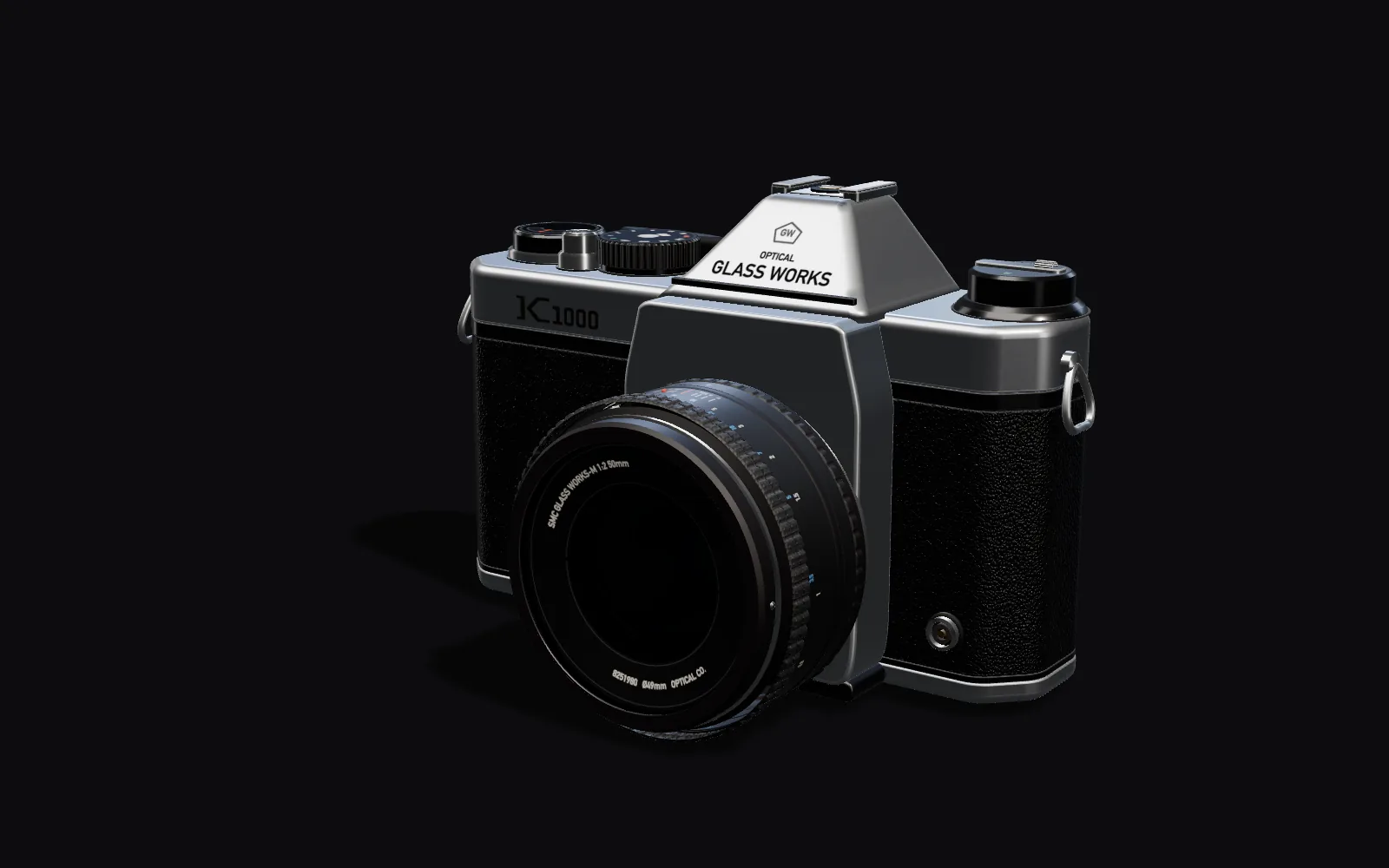
The plainest SLR of its line, made for twenty-one years and long the camera photography classes asked for.
- Turn on the cutaway and fire it to see the mirror swing up and the two silk curtains cross the frame.
- Take it apart in the exploded view, with every part named.
- Swap the 50 mm f/2 for the 28 mm wide lens or the 135 mm tele.
Shoot a roll with the K1000
A plain manual camera for learning exposure: meter a grey card in the Test Lab, then take the same thinking out to Yosemite's changing light.
The K1000, feature by feature
Plays from YouTube (privacy-enhanced mode). Nothing loads from YouTube until you press play. Privacy
The K1000
In 1975 its maker gave up its screw-in lenses for a new bayonet, the K mount, and launched three cameras around it: the K2, the KX and the KM. The K1000 followed a year later, in 1976, and it was the plainest of them. It is built on the KM, with the self-timer taken off and the depth-of-field preview too.
What is left is a shutter, a meter, a finder and a lever, and every setting is made by hand. The shutter is timed by springs and gears. The meter runs on one small cell and has no switch: take the lens cap off and it is on. If the battery dies, the camera still works at every speed, and you judge the light yourself.
That plainness kept it cheap and hard to break, and photography classes put it on their lists. It stayed in production for twenty-one years. Early cameras, like the one modeled here, were made in Japan with a metal top and base. Production moved to Hong Kong in 1978 and to mainland China in 1990, and later bodies had plastic top and bottom plates.
The controls, one by one
The K mount
Line up the red dot on the lens with the red dot on the body, push it in, and turn it clockwise until it clicks. A white bump on the barrel lets you find the spot by touch in the dark. Press the lens release lever and turn the lens back to take it off.
The lens
The 50 mm f/2 standard lens focuses down to 45 centimeters, and its aperture ring, nearest the body, clicks from f/2 to f/22. A depth-of-field scale sits between them. The lens stays wide open while you look and closes to your aperture only for the exposure.
The finder
A mirror and a pentaprism show the picture through the lens, upright and the right way round. Microprisms in the middle of the screen break the image into shimmering dots until it is in focus. On the right edge, a single meter needle sits between a plus and a minus.
One needle, not two
The meter's cadmium sulfide cells average the whole screen, with extra weight in the middle. They are linked to the aperture ring, shutter dial and film speed, so turning any of them moves the needle. People call it match-needle, but there is only one needle; its maker called it the zero method.
Shutter and flash
The dial runs from one second to a thousandth, plus B. Two curtains of rubberized silk run sideways just in front of the film. The orange 60, marked X, is the fastest speed for electronic flash, through the hot shoe on the prism or the socket on the front.
The wind lever
One stroke of about 160 degrees moves the film on a frame and cocks the shutter, and the lever ratchets, so short strokes work too. A dot beside the release shows red when the shutter is cocked, and the frame counter beside the lever moves on by one.
What it is
| Format | 24 × 36 mm on 35 mm film |
|---|---|
| Shutter | Rubberized-silk focal-plane, horizontal, mechanically timed |
| Speeds | 1 s to 1/1000 s and B; electronic flash at 1/60 |
| Meter | Through the lens, CdS cells, center-weighted; single needle; ASA 20–3200 |
| Finder | Fixed pentaprism, 0.88×; microprism center |
| Lens mount | K bayonet |
| Power | One 1.5 V LR44 or SR44 cell, for the meter only |
| Weight | 620 g body only; 790 g with the 50 mm f/2 |
| Made | Japan from 1976, later Hong Kong and China, to 1997 |
6 lenses
- 28 mm ƒ/2.8 WideWide
- 35 mm ƒ/2 WideWide
- 50 mm ƒ/2 StandardStandard
- 50 mm ƒ/1.7 StandardStandard
- 85 mm ƒ/2 PortraitPortrait
- 135 mm ƒ/3.5 TeleTele
Why it lasted
The K1000 lasted because it does very little for you. With no automation, no self-timer and no preview, every exposure is a decision the photographer makes, read off a single needle. That is why teachers chose it, and why it is still widely recommended as a first film camera, decades after the last one was made. Its K mount outlived it too: its maker still uses the same bayonet on its digital SLRs, so the lenses made for the K1000 still have a current body to go on.
Use this 3D model, or build another
The K1000 and its 6 lenses are built procedurally in Three.js from millimetre measurements — no external meshes or textures — and published under the MIT licence.