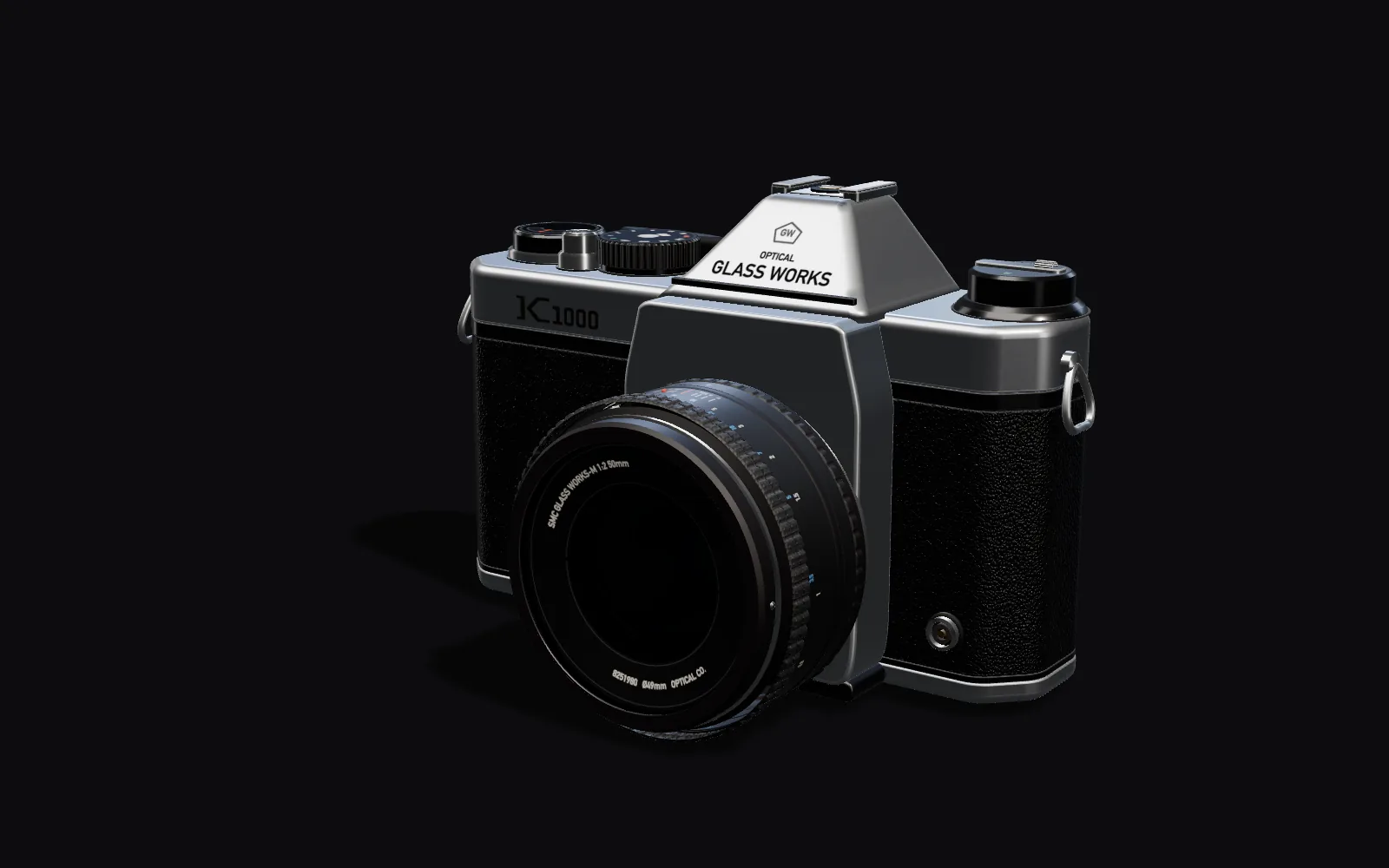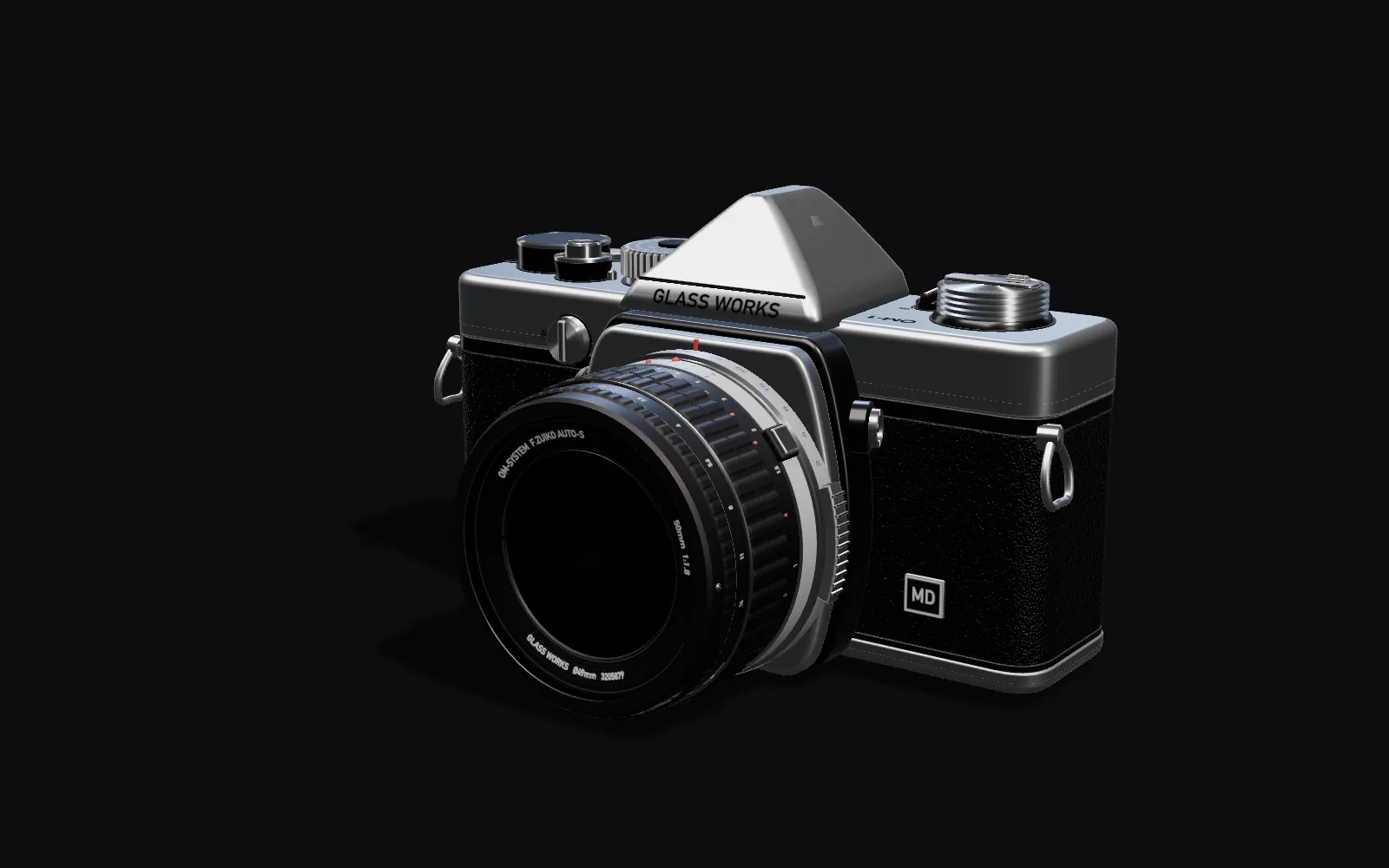
Cameras/F3
F3
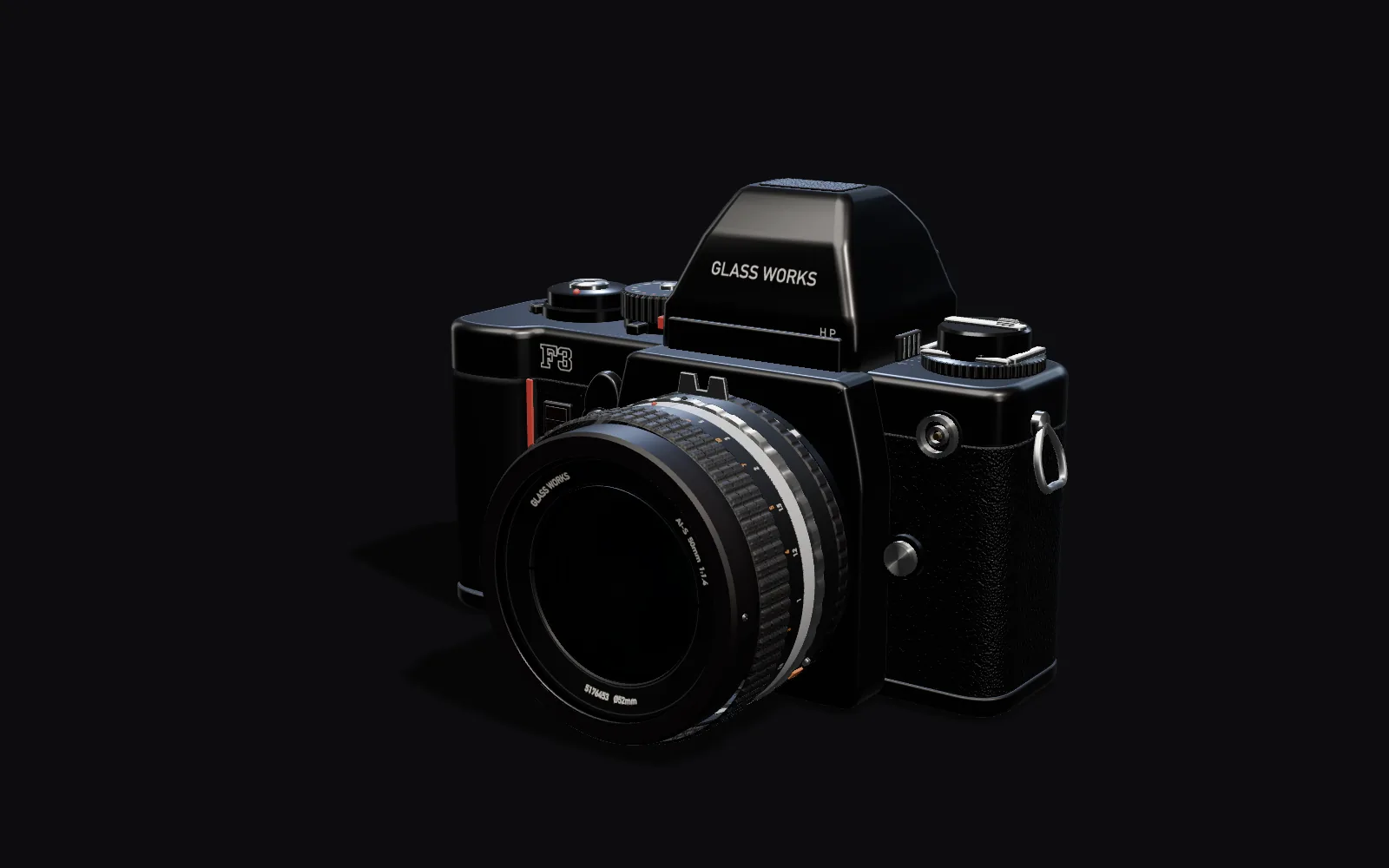
A professional SLR with a quartz-timed titanium shutter, an LCD finder and a car designer's styling.
- Press Finder to lift the high-eyepoint prism off and see the focusing screen beneath.
- Turn on the cutaway and fire it to watch the main mirror, with the small second mirror behind it, swing up.
- Swap the 50 mm f/1.4 for the 24 mm wide lens or the 105 mm portrait lens.
Shoot a roll with the F3
Its top speed of a two-thousandth and aperture priority suit bright Yosemite afternoons and portraits in the Loft Studio, and the Test Lab shows how its center-weighted meter treats a grey card.
The F3, feature by feature
Plays from YouTube (privacy-enhanced mode). Nothing loads from YouTube until you press play. Privacy
The F3
The F3 followed the F2, its maker's mechanical professional camera. Design work began in March 1977, and the prototype was finished in November 1978. The aims were high quality and reliability, ease of use, and automatic exposure, and that meant electronics and a battery. It went on sale in March 1980, in black, with a 50 mm f/1.4 lens, and for a while it was sold alongside the F2.
For the outside, its maker went to Giorgetto Giugiaro, the Italian designer best known for his cars. He shaped the body and its motor drive. The front has a sculpted grip for the right hand, and beside it a thin red line, which its maker says had a large influence on later camera designs. Some form of that red accent has stayed on its maker's cameras ever since.
Inside, it was the first of its maker's cameras to show readings on a liquid crystal display, chosen over LEDs because it used less power. The meter sits in the body, not the finder. About fifty thousand tiny holes in the middle of the main mirror let a little light through to a small second mirror, which sends it down to a silicon cell. So it works with any finder you put on top.
The F3HP, the version modeled here, was added in March 1982 with the high-eyepoint finder as standard. It shows the whole frame with your eye about 25 mm back from the eyepiece, a help if you wear glasses. More than 751,000 F3 cameras had been sold by September 1992, and it stayed in production into the 2000s, longer than any other of its maker's professional SLRs.
The controls, one by one
Aperture priority
Turn the dial to A and it locks there. You choose the aperture on the lens and the camera chooses the shutter speed, anywhere between eight seconds and a two-thousandth, not just the marked steps. Move the dial off A for manual, and an M appears in the finder.
The finder readouts
The aperture you set shows at the top of the view, read through a small window on the front of the prism. Beside it the liquid crystal display shows the camera's speed, or a plus and 2000 when there is too much light, and 8 with a minus when there is too little.
The removable finder
Slide the two release levers back and the whole finder lifts off, showing the focusing screen beneath, a split image inside a ring of microprisms. The screen lifts out too. Because the finder comes off, the flash shoe sits on the body, around the rewind knob.
The titanium shutter
Two curtains of thin titanium foil run sideways across the frame, timed by a quartz crystal. The whole frame is open at once at an eightieth or slower, so X on the dial sets an eightieth for flash. The mirror swings up for the exposure and drops straight back.
The mechanical backup
Two small silver-oxide cells in the baseplate power the camera. If they die, a small lever beside the lens mount still fires the shutter mechanically at about a sixtieth, whatever the dial says, and the T setting holds the shutter open without drawing any power.
Front controls
The depth-of-field preview button closes the lens to your aperture, and the lever around it locks the mirror up. A memory lock button holds a reading while you recompose, and a compensation dial by the rewind knob shifts the exposure up to two stops either way.
What it is
| Format | 24 × 36 mm on 35 mm film |
|---|---|
| Shutter | Titanium-foil focal-plane, horizontal, quartz-timed; mechanical 1/60 backup |
| Speeds | 8 s to 1/2000 s (stepless on A), B and T; flash X at 1/80 |
| Meter | Through the lens, in the body, silicon cell, center-weighted; aperture-priority auto; ISO 12–6400 |
| Finder | Removable high-eyepoint prism (DE-3) with LCD readout; interchangeable screens |
| Lens mount | F bayonet (AI-S lenses) |
| Power | Two 1.55 V silver-oxide or 1.5 V alkaline cells, or one 3 V lithium cell |
| Made | Japan, from 1980 into the 2000s; the F3HP from 1982 |
7 lenses
- 24 mm ƒ/2.8 WideWide
- 28 mm ƒ/2.8 WideWide
- 35 mm ƒ/2 WideWide
- 50 mm ƒ/1.4 StandardStandard
- 85 mm ƒ/2 PortraitPortrait
- 105 mm ƒ/2.5 PortraitPortrait
- 135 mm ƒ/2.8 TeleTele
Why it lasted
The F3 kept the old professional features, a removable finder, interchangeable screens, a motor drive and a shutter that still works without power, and added automatic exposure and an electronic display. NASA ordered cameras based on it in 1978, and one flew on the Space Shuttle Columbia in April 1981. Its red line and sculpted grip set a style its maker has kept. Because of the mechanical speed held in reserve, a working F3 can still take a picture with flat batteries, more than forty years after it first went on sale.
Use this 3D model, or build another
The F3 and its 7 lenses are built procedurally in Three.js from millimetre measurements — no external meshes or textures — and published under the MIT licence.