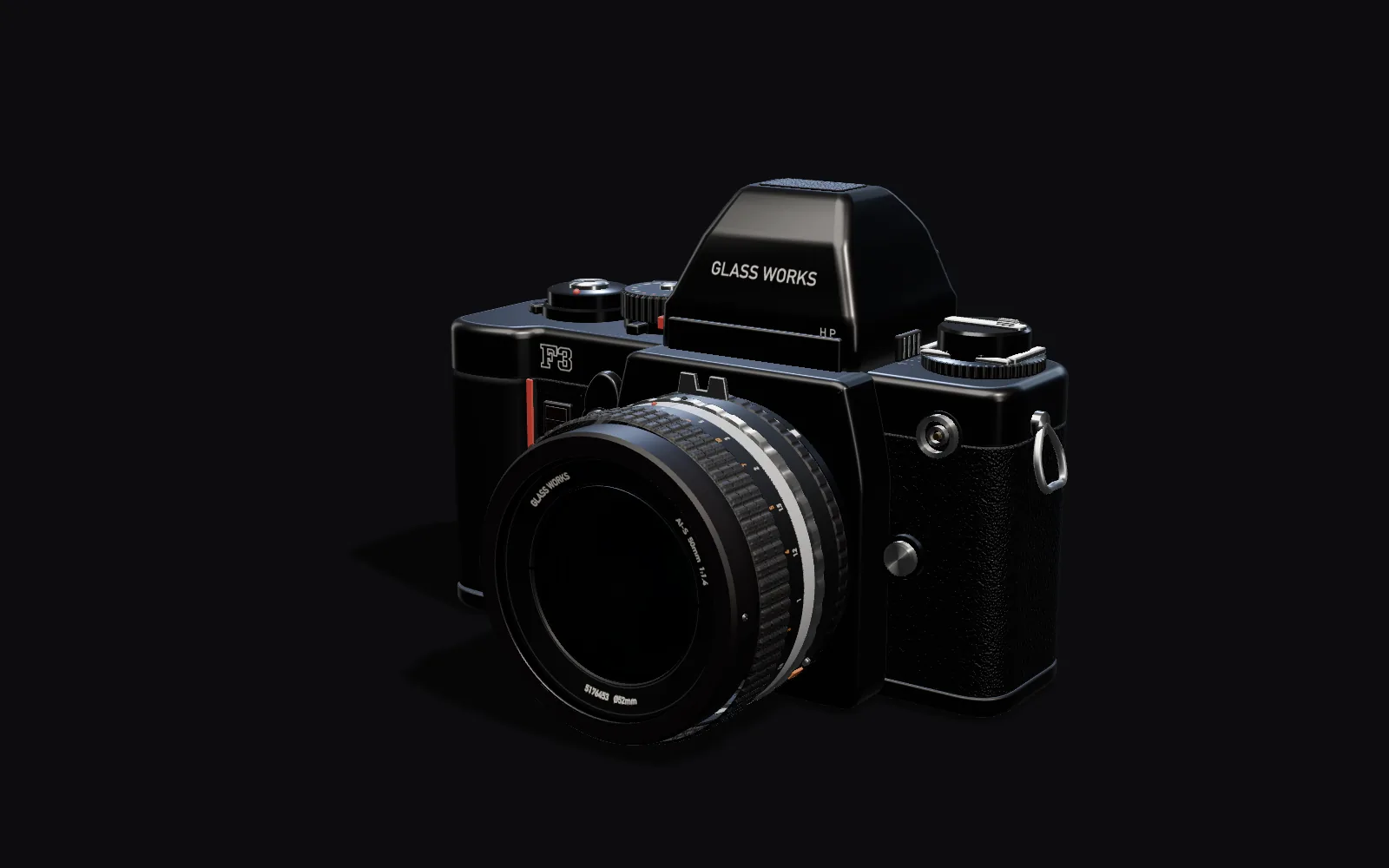
Cameras/OM-1
OM-1
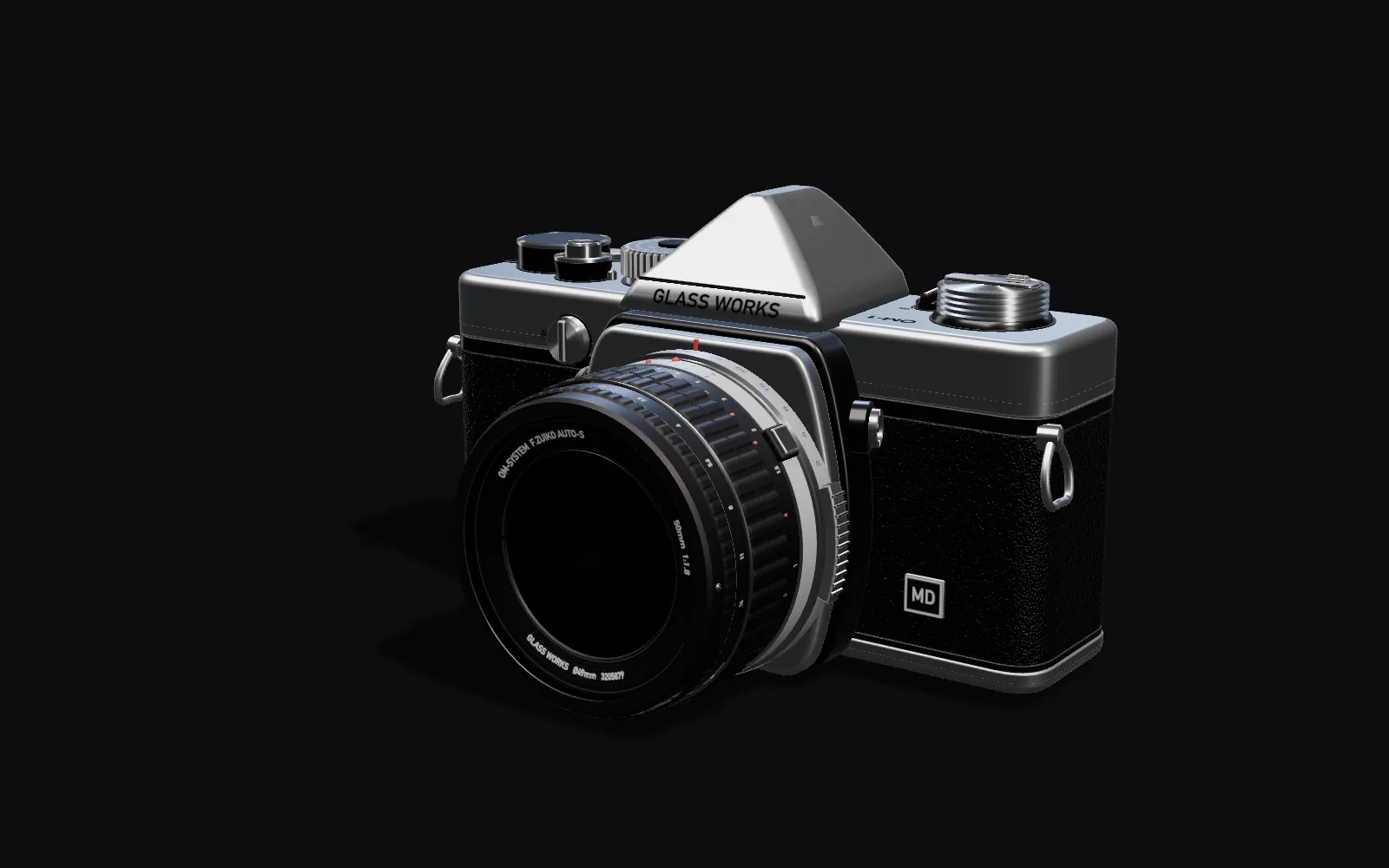
A full system SLR made much smaller and lighter, with shutter speeds on a ring around the lens.
- Take it apart in the exploded view and find the shutter speed ring around the lens mount.
- Turn on the cutaway and fire it to watch the mirror swing up and the cloth curtains cross the film.
- Swap the 50 mm f/1.8 for the 24 mm wide lens or the 135 mm tele.
Shoot a roll with the OM-1
Its small body and lenses from 24 mm to 135 mm suit Yosemite's landscapes and the Loft Studio's portraits, and the Test Lab shows how its centered-needle meter reads a grey card.
The OM-1, feature by feature
Plays from YouTube (privacy-enhanced mode). Nothing loads from YouTube until you press play. Privacy
The OM-1
By the late 1960s professional SLRs had grown heavy and bulky. The OM-1's designer, who had already made half-frame cameras for the same company, wanted one that was much smaller and lighter and still a complete system camera. He spent the whole of 1967 persuading the company's management to build it. He also aimed for a quieter mirror and shutter, with less shock when they move.
The camera was first shown at photokina in Cologne in 1972, as the M-1. A German maker that had used the letter M for its rangefinders since 1954, and had even sold a camera called the M1, objected to the name. In 1973 it became the OM-1. Its maker called it the smallest and lightest 35 mm SLR in the world.
The body is 136 mm wide, 83 mm high and 50 mm deep, and weighs a little over 500 grams. Part of the saving is in the prism. The separate condenser lens that usually sits above the focusing screen was left out, and the underside of the prism curved instead. Even so, the finder is large: magnified 0.92 times with the 50 mm lens, and showing 97 percent of the frame.
The OM-1 was the first body of a whole system, with lenses, motor drives, close-up gear and microscope adapters built around it. The version modeled here is the OM-1 MD, from 1974. It takes the motor drive without any changes, for up to five frames a second, and its hinged back comes off for a data back or a back that holds 250 exposures.
The controls, one by one
The speed ring
There is no shutter speed dial on the top plate. The speeds are on a ring around the lens mount, turned by two small tabs, from one second to a thousandth, plus B. Its designer said the mount had room inside where other areas were crowded, and it puts focus, aperture and speed all at the lens.
The lens
The standard lens is the 50 mm f/1.8. Its aperture ring is at the very front of the barrel, from f/1.8 to f/16, with the focusing ring behind it, down to 45 centimeters. The lens stays open while you compose, and a preview button on its side closes it to check depth of field.
The meter
Two cadmium sulfide cells, one on each side of the eyepiece, read through the lens, and a switch on the top plate turns them on. Set the film speed on the dial beside the release, from ASA 25 to 1600, then turn either ring until the needle in the finder rests in the middle.
Mirror and shutter
Press the release and the mirror swings up as the lens closes. Two cloth curtains cross the film; the speeds up to a sixtieth are printed in blue, since that is the fastest for electronic flash. An air damper cushions the mirror, and the shutter was rated for a hundred thousand cycles.
The battery
One small mercury cell runs the meter, and that is all it does. The shutter, the mirror and the film advance are mechanical, so with a dead battery the camera still takes pictures at every speed, and you judge the light yourself.
Wind and mirror lock-up
The wind lever travels 150 degrees, in one stroke or several short ones, and moves the frame counter on. For close-ups, where even a small shock matters, the lever beside the mount turns a quarter turn and holds the mirror up before you fire.
What it is
| Format | 24 × 36 mm on 35 mm film |
|---|---|
| Shutter | Cloth focal-plane, horizontal, mechanical; speed ring around the lens mount |
| Speeds | 1 s to 1/1000 s and B; electronic flash at 1/60 |
| Meter | Through the lens, two CdS cells beside the eyepiece; centered needle; ASA 25–1600 |
| Finder | Fixed pentaprism, 0.92×, 97% of the frame; interchangeable screens |
| Lens mount | OM bayonet, 70° turn |
| Power | One 1.35 V mercury cell (PX625), for the meter only |
| Size | 136 × 83 × 50 mm; 510 g body only |
| Made | Japan, 1972–1988 |
7 lenses
- 24 mm ƒ/2.8 WideWide
- 28 mm ƒ/3.5 WideWide
- 35 mm ƒ/2.8 WideWide
- 50 mm ƒ/1.8 StandardStandard
- 50 mm ƒ/1.4 Fast StandardStandard
- 85 mm ƒ/2 PortraitPortrait
- 135 mm ƒ/3.5 TeleTele
Why it lasted
The OM-1 made its designer's point: a full system SLR could be small and light and still take a whole range of lenses, motor drives and scientific accessories. Swap the 50 mm for a 24 mm or a 135 mm, and every control stays where your hand expects it. Because only the meter needs a battery, owners today fit a mercury-free substitute cell or meter by hand, and the rest of the camera works as it always did. A great many are still working, more than fifty years after it was first shown.
Use this 3D model, or build another
The OM-1 and its 7 lenses are built procedurally in Three.js from millimetre measurements — no external meshes or textures — and published under the MIT licence.