Cameras/503CX
503CX
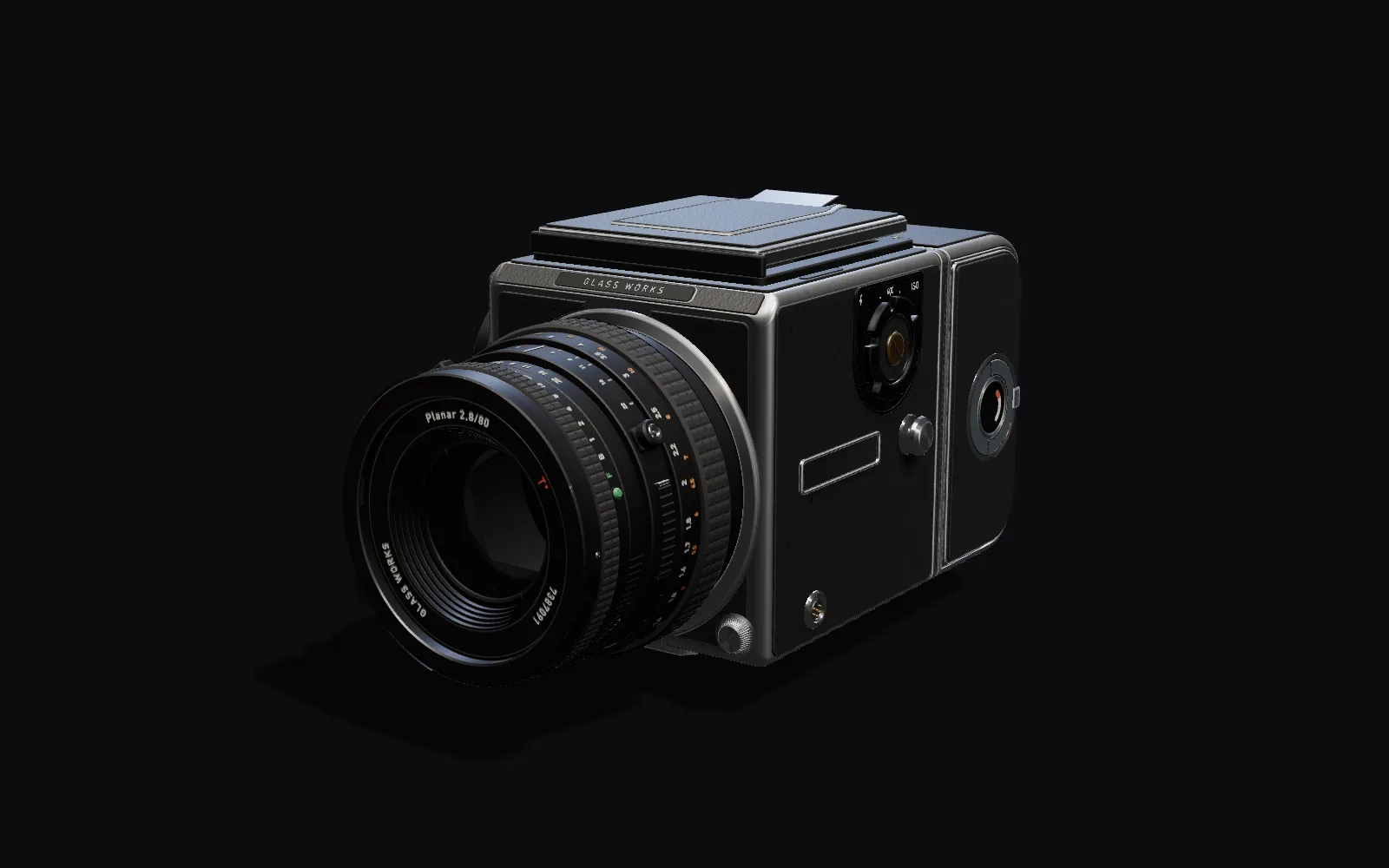
A medium-format camera in four parts, with a shutter in every lens and no battery.
- Take it apart in the exploded view and see the four parts, lens, body, finder and magazine, each named.
- Turn on the cutaway and fire it to watch the mirror swing up inside the body.
- Swap the 80 mm f/2.8 standard lens for the 30 mm fisheye or the 500 mm super-telephoto.
Shoot a roll with the 503CX
The square frame suits the Loft Studio's still life and portraits, and the lenses from 30 mm to 500 mm cover Yosemite from wide valley views to a single distant cliff.
The 503CX, feature by feature
Plays from YouTube (privacy-enhanced mode). Nothing loads from YouTube until you press play. Privacy
The 503CX
The 503CX came out in 1988, the latest step in a line of Swedish cameras that began in 1948. The idea behind that line never changed. The camera is four parts that lock together: a lens on the front, a body in the middle, a finder on top and a film magazine on the back. Each one can be swapped, so you can change the lens, change the way you look, or take the film off halfway through a roll and put a different film on.
The big change came in 1957, with the 500C. It dropped the shutter in the body and put a leaf shutter in every lens instead. A ring of thin steel blades opens from the center and uncovers the whole frame at once, so flash works at every speed, even a five-hundredth of a second in bright sun. That is a large part of why studio and wedding photographers took to these cameras. The 503CX still takes almost every lens made for the system since 1957.
The 503CX was an upgraded 500C/M, the model of 1970. It kept the body shell, cast in one piece of aluminum alloy, and the same mechanical workings. What it added was a flash sensor inside the body that reads the light reflected off the film during the exposure and cuts the flash off when there is enough. It also came with a much brighter focusing screen, the Acute-Matte, and a new coating inside the body to cut flare.
It was made until 1994, when the 503CXi added a connection for a winder. In 1996 the 503CW followed, with a mirror that glides back as it rises, so long lenses no longer darken the top of the screen. The 503CX has neither. It is the plain mechanical camera of the line, and its one piece of electronics, the flash control, runs on power from the flash unit itself.
The controls, one by one
The waist-level finder
Flip up the lid and the hood unfolds, four thin walls that keep stray light off the screen. You look down at the picture, full size and upright but reversed left to right. A magnifier flips up inside for critical focus, and both the finder and the screen lift off.
The lens and its shutter
Each lens carries its own leaf shutter, from one second to a five-hundredth, plus B. Behind the focusing ring sit the aperture ring and, nearest the body, the speed ring. A small button couples the two, so they turn together and keep the same exposure while you choose another pair.
Pressing the release
Press the release on the front and four things happen in a strict order. The lens closes and stops down, the mirror swings up, the two rear blinds open, and only then does the lens shutter make the exposure. The mirror stays up, and the finder dark, until you wind.
The crank
One turn of the crank closes the blinds, brings the mirror down, opens the lens again, moves the film on a frame and cocks the shutter. A small window by the crank shows white when the camera is wound and red once it has fired.
The A12 magazine
The magazine takes 120 roll film and gives twelve frames, each 56 mm square. A dark slide seals the film, so the magazine can come off in the middle of a roll. The camera won't fire with the slide in, and the magazine won't come off with the slide out.
The pre-release
The mirror is big and swings up hard enough to blur a slow exposure. Press the pre-release first, and the lens closes and the mirror and blinds go up ahead of time. Let the camera settle, then fire, and only the quiet leaf shutter moves.
What it is
| Format | 6×6 cm on 120 film, 12 frames of 56 × 56 mm (A12 magazine) |
|---|---|
| Shutter | Leaf shutter in each lens, plus two rear blinds in the body that guard the film |
| Speeds | 1 s to 1/500 s and B; flash at every speed |
| Meter | No exposure meter; through-the-lens flash control reads off the film, ISO 16–1000 |
| Finder | Interchangeable; folding waist-level hood with magnifier, Acute-Matte screen |
| Lens mount | The system bayonet: takes almost every lens made for it since 1957 |
| Power | None; a dedicated flash unit powers the flash control |
| Weight | Body 610 g; 1,510 g with the 80 mm lens and A12 magazine |
| Made | Sweden, 1988–1994 |
11 lenses
- 30 mm ƒ/3.5 FisheyeFisheye
- 40 mm ƒ/4 WideWide
- 50 mm ƒ/4 WideWide
- 60 mm ƒ/3.5 WideWide
- 80 mm ƒ/2.8 StandardStandard
- 100 mm ƒ/3.5 StandardStandard
- 120 mm ƒ/4 MacroMacro
- 150 mm ƒ/4 PortraitPortrait
- 180 mm ƒ/4 TeleTele
- 250 mm ƒ/5.6 TeleTele
- 500 mm ƒ/8 Super-teleSuper-tele
Why it lasted
Photographers used the 500 cameras in studios, at weddings and in the field. Ansel Adams made Moon and Half Dome in 1960 with a 500C, working from a tripod with a cable release. A motorized relative in the same system, the 500EL, was adapted for NASA as a camera for the Moon. The manual line ran until 2013, and a digital back made for the latest body still fits the oldest 500C. The 503CX lasts because nothing in its mechanism needs electricity, and every movement is one you can hear and feel.
Use this 3D model, or build another
The 503CX and its 11 lenses are built procedurally in Three.js from millimetre measurements — no external meshes or textures — and published under the MIT licence.